
GPA Scale: Letter Grades, Grade Points, and Percentages
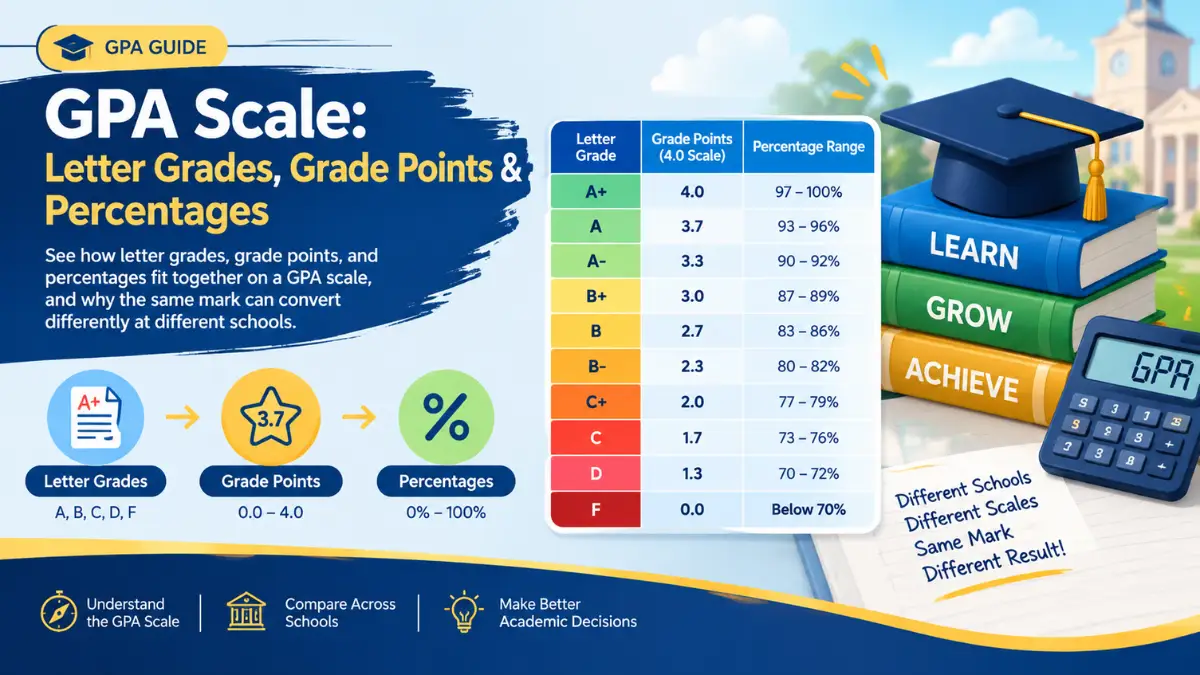
A GPA scale is the table your school uses to turn a grade into grade points. On the most common US scale, an A is worth 4.0, a B is 3.0, a C is 2.0, a D is 1.0 and an F is 0. Many schools add plus and minus steps, such as A- = 3.7 and B+ = 3.3. Percentages are different: there is no single national or global table that converts marks into letters, so the same percentage can land on different grades at different schools. Always use the scale published by your own institution.
Quick facts
| What it does | Converts letter grades or marks into grade points |
| Most common range | 0.0 to 4.0 |
| Typical top grade | A = 4.0 (A+ is 4.0 at many schools, 4.3 at some) |
| Failing grade | F = 0.0 |
| Plus/minus steps | Common, but not universal |
| Percentage to letter | Set by each school, and sometimes by program or instructor |
| Weighted scales | High schools may go above 4.0 for advanced courses |
What is a GPA scale?
Every GPA starts with a scale. Before you can multiply grade points by credit hours, you need to know how many grade points a B+ or a 78% is worth, and that answer comes from your institution’s grading policy.
Most scales have two layers. The first layer converts marks to letters, for example 85–89 to an A. The second layer converts letters to grade points, for example A to 4.0. At one Canadian university, the standard percentage table is a default: instructors may use a different one as long as they state it in the syllabus and announce it early in the course. twu
The common 4.0 letter-grade scale
One widely used version looks like this. Several universities publish these same values. smartcatalogiqupenn
| Letter | Grade points |
|---|---|
| A+ | 4.0 |
| A | 4.0 |
| A- | 3.7 |
| B+ | 3.3 |
| B | 3.0 |
| B- | 2.7 |
| C+ | 2.3 |
| C | 2.0 |
| C- | 1.7 |
| D+ | 1.3 |
| D | 1.0 |
| D- | 0.7 |
| F | 0.0 |
The logic is easy to see. Each full letter is one point apart, and plus and minus grades sit about a third of a point above or below it. Even in this “standard” version, schools make their own choices. One university’s published scale has no D-. At another, pass/no-pass grades are left out of the average, and interim grades such as I earn no grade points until a final letter grade replaces them.
Where scales differ
How A+ is handled: Many schools give A+ the same 4.0 as an A. Some go higher: one university’s table gives A+ a 4.3 and an A a 4.0. Others have no A+ at all, and a proposal at one US university to add it considered a value of either 4.33 or 4.00. The proposal argued that without an A+ above the A, a student with even one A- can never return to a perfect 4.0. nsysuwichita
How precise the points are: The A- can be 3.7, 3.67 or 3.66, depending on the institution. Among Pakistani institutions, one graduate grading policy uses 3.67 for A- and 3.33 for B+, another university’s page uses 3.66 and 3.33, and a third institute uses 3.70 and 3.30. The differences are small per course, but they can move a cumulative GPA in the second decimal place. Grading Policy +2
Half-point scales: One university’s undergraduate scale skips minus grades and runs A = 4.00, B+ = 3.50, B = 3.00, C+ = 2.50 and so on down to D = 1.00.
Different scales for different levels: That same university uses a different scale at graduate level, with plus and minus grades and values such as 3.67 and 3.33. A student who studies at two levels may meet two scales at one institution. ru
Program-level rules: Even within one university, a program handbook may set its own scale. One US program handbook uses a single A band for 89.50–100 worth 4.0, and treats anything below 69.50 as unsatisfactory with zero points. It also says grades are calculated to two decimals with no rounding.
Converting percentages to letters and points
There is no universal formula. Each institution publishes its own bands, and the differences are easiest to see by comparing the same mark across several published tables.
| Percentage | University of Toronto (Arts & Science) | National Sun Yat-sen University (Taiwan) | Pakistani university (band table) | Pakistani institute, CS program | Pakistani institute, CE program |
|---|---|---|---|---|---|
| 90% | A+ (4.0) | A+ (4.3) | A+ (4.00) | A (4.00) | A (4.00) |
| 82% | A- (3.7) | A- (3.7) | A- (3.66) | A- (3.70) | B+ (3.30) |
| 78% | B+ (3.3) | B+ (3.3) | B+ (3.33) | B+ (3.30) | B (3.00) |
| 72% | B- (2.7) | B- (2.7) | B (3.00) | B- (2.70) | B- (2.70) |
Each column comes from that institution’s own published grading table.
- Two programs in the same institute can differ: The institute’s CS program treats 85 and above as an A, while its CE program requires 90.
- A grade point value does not fix a percentage band: A B is worth 3.0 in the Pakistani university and CE columns, and yet it starts at 70% in one and 75% in the other.
- Band tables are guidelines for a particular kind of marking: The institute says its bands are for absolute grading and project evaluation, so a course graded on a curve may follow other rules.
One Pakistani university even publishes a second, mark-by-mark table alongside its bands. In that table, 82% corresponds to 3.80, 78% to 3.53 and 72% to 3.13, rather than the flat band values shown above. That is why you should follow the method your university’s regulations specify, not a generic online converter. If a shortcut formula online promises to convert percentage to GPA for every school, treat it as a rough estimate at best.
Worked example
Take four courses: a 3-credit course with an A+, a 3-credit course with an A-, a 4-credit course with a B+, and a 2-credit course with a B. That is 12 credits in total. The numbers below are my own illustration.
| Scale | A+ | A- | B+ | B | Quality points | GPA |
|---|---|---|---|---|---|---|
| A: standard 4.0 (A+ = 4.0) | 4.0 | 3.7 | 3.3 | 3.0 | 42.30 | 3.525 |
| B: A+ worth 4.3 | 4.3 | 3.7 | 3.3 | 3.0 | 43.20 | 3.600 |
| C: two-decimal thirds | 4.00 | 3.67 | 3.33 | 3.00 | 42.33 | 3.528 |
Here is the calculation for scale A: (3 × 4.0) + (3 × 3.7) + (4 × 3.3) + (2 × 3.0) = 12 + 11.1 + 13.2 + 6 = 42.3, and 42.3 ÷ 12 = 3.525.
The same transcript gives about 3.53 or 3.60, depending on the scale. Precision differences like 3.7 versus 3.67 barely matter here, while the treatment of A+ matters a lot. That is why you should never compare GPAs from different institutions without checking their scales first.
Weighted scales
High schools often add extra points for advanced courses. Some schools cap the scale at 4.5, some add a full point only for AP and IB, and some use 6.0, 7.0 or even 12-point systems. The legend on your transcript defines your school’s scale, and colleges receive that legend along with your grades. See Weighted vs Unweighted GPA for how this affects admissions, and How AP and IB Classes Boost Weighted GPA for examples.
Other systems: 10-point scales and beyond
Not every country uses a 4.0 scale. Many institutions in India report results on a 10-point scale, with the UGC recommending a 10-point system. Pakistan uses a mix: many universities report on a 4.0 scale, but each publishes its own table. Other systems use percentages or classifications like first class and second class. Converting between these is a separate problem, and we cover it in our upcoming conversion guides. For now, remember that a 3.5 on a 4.0 scale and an 8.5 on a 10-point scale are not directly comparable.
Common mistakes
- Using someone else’s percentage table: A friend’s university may use different bands.
- Assuming A+ is always 4.3: At most schools it is 4.0, and some have no A+.
- Mixing scales in one calculation: Convert everything to one scale before averaging.
- Rounding grade points too early: Keep two or three decimals until the final GPA.
- Ignoring grades outside the scale: Pass/fail, withdrawals and incompletes usually carry no grade points.
- Trusting generic converters for official use: Applications and scholarships usually specify their own method.
How to find your own scale
Search your university’s academic regulations, student handbook or registrar page for a “grading system” or “grade points” table. Look for three things: the letter-to-points table, the marks-to-letter bands, and any rule for pass/fail, repeats and rounding. If your program has its own handbook, check that too. If you cannot find a table, ask your registrar or examination office.
Try the calculator
Use the College GPA Calculator with your school’s grade points, or open the Pakistan University GPA Calculator if you study in Pakistan. High school students can use the High School GPA Calculator.
Related guides
- What Is GPA? Complete Guide to Grade Point Average
- How to Calculate College GPA
- United States Grading System and GPA Guide
- Pakistan Grading System and CGPA Guide
- GPA vs CGPA: Key Differences