
Weighted vs Unweighted GPA: Which One Do Colleges Look At?
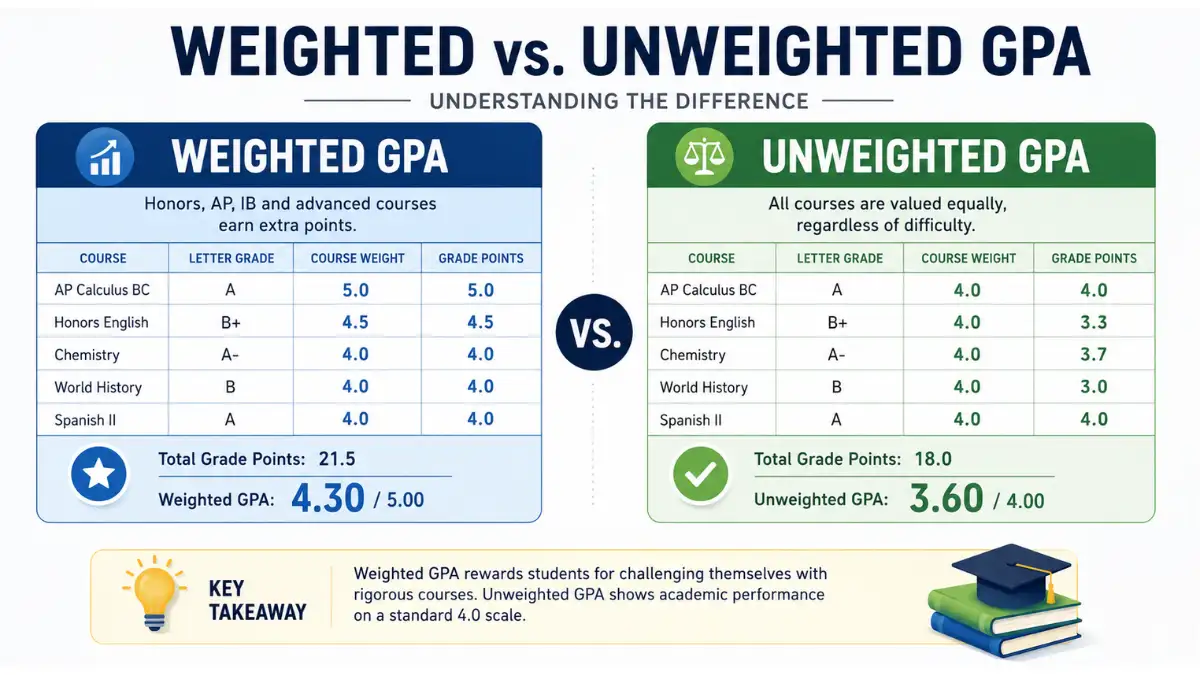
Every year, millions of high school students preparing college applications face the same burning question: which GPA do colleges actually care about — weighted or unweighted? The short answer is: both matter, but in very different ways. The long answer requires understanding how admissions offices think, how GPA scales work, and what truly differentiates a compelling application.
In this guide, we break down the weighted vs unweighted GPA debate from the college admissions perspective, explain how top universities evaluate your academic record, and give you actionable insights to present your GPA in the strongest possible light.
What Is an Unweighted GPA?
An unweighted GPA is calculated on a standard 4.0 scale, regardless of course difficulty. Whether you earned an A in AP Calculus or an A in basic Math, both contribute the same 4.0 points to your GPA.
Unweighted GPA Scale
| Letter Grade | Percentage Range | Unweighted GPA Points |
| A+ | 97–100% | 4.0 |
| A | 93–96% | 4.0 |
| A- | 90–92% | 3.7 |
| B+ | 87–89% | 3.3 |
| B | 83–86% | 3.0 |
| B- | 80–82% | 2.7 |
| C+ | 77–79% | 2.3 |
| C | 73–76% | 2.0 |
Key characteristics of unweighted GPA:
- Consistent and easy to compare across schools
- Does not account for AP, IB, Honors, or dual enrollment courses
- Most commonly reported on a 4.0 scale
- Preferred by some colleges for straightforward academic comparison
What Is a Weighted GPA?
A weighted GPA adjusts for course rigor by awarding extra grade points for advanced coursework. Most schools use a 5.0 scale for weighted GPAs, though some use 4.5 or other variations. An A in an AP class on a 5.0 weighted scale earns 5.0 points instead of the standard 4.0.
Weighted GPA Scale (Typical 5.0 System)
| Course Type | A Grade Points | B Grade Points | C Grade Points |
| Regular | 4.0 | 3.0 | 2.0 |
| Honors | 4.5 | 3.5 | 2.5 |
| AP / IB / College | 5.0 | 4.0 | 3.0 |
Key characteristics of weighted GPA:
- Rewards students for taking more challenging courses
- Can exceed a 4.0 (often goes up to 5.0 or higher)
- Varies significantly between schools and districts
- Reflects academic ambition alongside academic achievement
Still confused? Use this free online calculator to find your weighted and unweighted GPA.
Weighted vs Unweighted GPA Key Differences at a Glance
| Feature | Unweighted GPA | Weighted GPA |
| Scale | 0–4.0 | 0–5.0 (or higher) |
| Course Rigor | Not considered | Rewarded with bonus points |
| Consistency | Highly consistent | Varies by school |
| Colleges’ Use | Baseline comparison | Shows academic ambition |
| Common Reporters | Most high schools | Schools with AP/IB programs |
| Recalculated? | Sometimes | Often recalculated by colleges |
What Do Colleges Actually Look At?
Here is where many students, and even parents, get confused. Most highly selective colleges do not simply plug your weighted or unweighted GPA into their system. Instead, they evaluate your transcript holistically, and many recalculate your GPA entirely.
The Holistic Transcript Review
Admissions officers examine several elements beyond the GPA number:
- Course rigor: the type and difficulty of classes taken
- Grade trends: whether grades improved over time
- Class rank: how you performed relative to your peers
- School profile: the opportunities available at your specific school
- Subject-specific performance: strength in areas relevant to your intended major
How Colleges Recalculate GPA
Many universities, including most University of California campuses and several Ivy League schools, recalculate applicants’ GPAs using their own standardized formulas. This process strips away local weighting systems and applies a consistent scale across all applicants.
The UC system, for example:
- Considers only academic (non-elective) courses in grades 10 and 11
- Adds bonus points for UC-approved honors, AP, and IB courses
- Caps bonus points at eight semesters of approved courses
- Recalculates on a scale that may differ from both your school’s weighted and unweighted GPA
What Ivy League and Top Universities Say
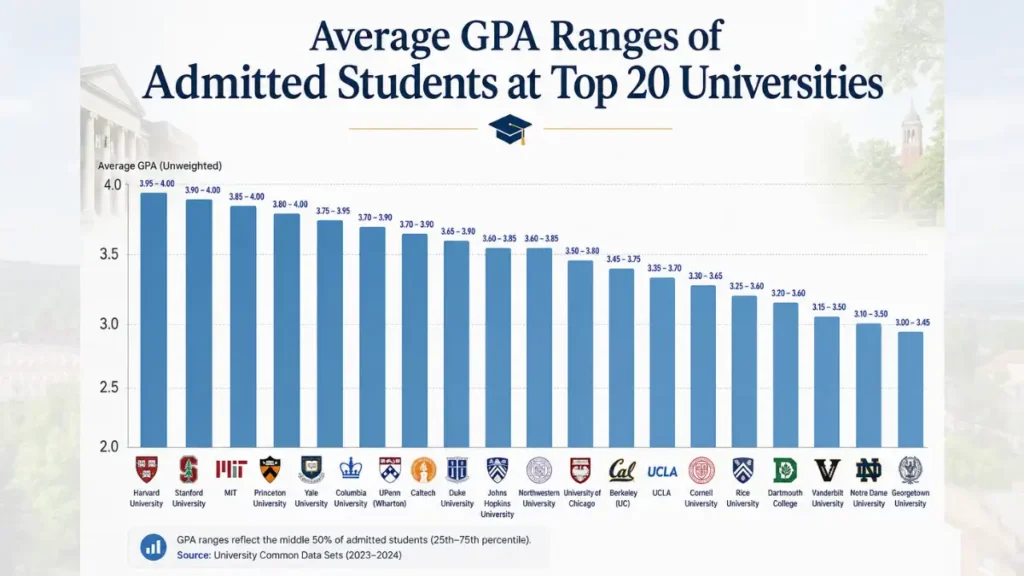
Schools like Harvard, MIT, Stanford, and Yale do not publish a minimum GPA cutoff. Their admissions offices evaluate the academic record in the context of what was available at the applicant’s school. A student at a school that offers no AP courses is not penalized for not taking them; admissions officers are trained to read school profiles carefully.
According to publicly available admissions data, most admitted students at highly selective schools have unweighted GPAs of 3.9 or above, but the actual threshold varies significantly depending on the full profile of the application.
Course Rigor: The Hidden Factor That Outweighs GPA
Here is the most important insight from the college admissions perspective: course rigor often matters more than the GPA number. An admissions officer at a top university will typically prefer a student with a 3.7 unweighted GPA who took eight AP courses over a student with a 4.0 unweighted GPA who took only standard-level classes.
This is why:
- Selective colleges want students who will thrive in rigorous college coursework
- AP, IB, and dual enrollment courses signal readiness for college-level academics
- Taking the hardest available courses demonstrates intellectual curiosity and ambition
- A high grade in an easy course tells admissions officers less than a good grade in a hard one
How to Strike the Right Balance
Students should challenge themselves, but not to the point of academic burnout. Admissions officers have noted that a few B grades in very challenging courses are far better than straight As in all easy ones. The goal is to maximize rigor while maintaining solid grades — not to sacrifice one for the other entirely.
Weighted GPA and Class Rank
At schools that report class rank, weighted GPA is often used to determine ranking. This means that taking more AP and honors courses can significantly improve your class rank, which is a separate (and sometimes important) data point colleges use.
Class rank matters most at:
- Public flagship universities that use automatic admission thresholds (e.g., top 6% in Texas)
- Schools that explicitly request class rank on the Common App
- Scholarship programs that set cutoffs based on rank
However, many high schools have moved away from reporting class rank entirely, recognizing that it can discourage students from taking challenging courses if it risks lowering their ranking. In the absence of rank, colleges rely even more heavily on the transcript and school profile.
How to Present Your GPA Effectively
On the Common Application
The Common App asks you to self-report your GPA and specify the scale. If your school uses a weighted scale, report that GPA and select the correct scale. You may also report your unweighted GPA if it differs. Honesty is critical — your high school transcript will be sent to colleges and must match what you self-report.
In Your Additional Information Section
If your school has an unusual grading system, or if your GPA does not reflect your ability (for example, due to a difficult personal period in freshman year), the Additional Information section is the place to provide context. Admissions officers appreciate transparency when it is paired with evidence of growth.
Talking to Your School Counselor
Your school counselor’s letter of recommendation and the school profile sent to colleges provide critical context for your GPA. Make sure your counselor is aware of any extenuating circumstances that affected your grades, as they can address these in their letter.
GPA Benchmarks by College Selectivity Tier
To give you a practical reference, here are general GPA benchmarks by college tier. Note that these are estimates based on reported admissions data and should be verified with each institution’s official resources.
| College Tier | Typical Unweighted GPA Range | Typical Weighted GPA Range |
| Highly Selective (Top 20) | 3.85 – 4.0+ | 4.5 – 5.0+ |
| Selective (Top 50) | 3.7 – 3.9 | 4.2 – 4.8 |
| Moderately Selective (Top 100) | 3.5 – 3.8 | 3.9 – 4.5 |
| Less Selective / Open Admissions | 2.5 – 3.5 | Varies widely |
Common Myths About GPA and College Admissions
Myth 1: A Higher Weighted GPA Always Beats a Lower Unweighted GPA
Not necessarily. A 4.8 weighted GPA achieved through easy honors courses at a school with inflated grading may be viewed less favorably than a 3.9 unweighted GPA from a rigorous academic environment where the student took every available AP course.
Myth 2: Colleges Only Look at Your GPA
GPA is just one element in a multi-factor admissions process. Standardized test scores (where required), extracurricular activities, essays, letters of recommendation, demonstrated interest, and special talents all play a role — especially at selective schools.
Myth 3: You Must Have a Perfect GPA to Get Into a Top School
While most admitted students at Ivy League schools have very high GPAs, students with lower GPAs are regularly admitted based on exceptional achievement in other areas, unique backgrounds, or extraordinary talent. Context always matters.
Conclusion
When it comes to the weighted vs unweighted GPA debate from a college admissions perspective, the most honest answer is this: colleges look at both, but neither in isolation.
Here is what matters most:
- Take the most rigorous courses your school offers, and perform well in them
- Understand that many selective schools will recalculate your GPA anyway
- Use your transcript as a story of intellectual growth and challenge
- Provide context through your counselor, the additional information section, or essays
- Focus on building the strongest overall application, not just chasing a GPA number
Your GPA, weighted or unweighted, is a signal, not a verdict. What colleges truly want to see is a student who has pushed themselves, learned from challenges, and is ready for the academic demands of higher education. That story is told by your entire transcript, not just a single number.