
US Grading Systems: GPA Systems and Common Grading Concepts
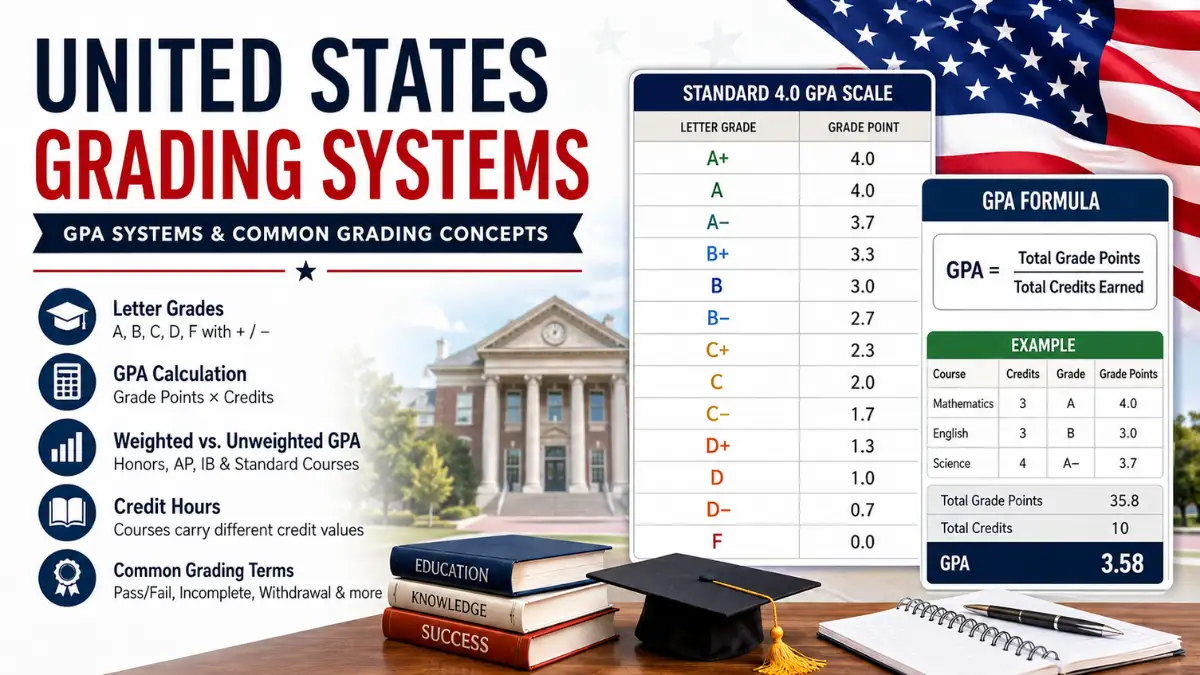
Understanding the United States grading system can be confusing, especially for international students and anyone comparing academic results across different schools or universities. Unlike countries that use one nationwide grading formula, grading policies in the United States can vary by school, college, university, program, and instructor.
However, most American educational institutions use a familiar combination of letter grades, grade points, course credits, and Grade Point Average (GPA).
This guide explains the most common U.S. grading systems, how GPA works, how grades are calculated, and important concepts such as weighted GPA, unweighted GPA, cumulative GPA, credit hours, and Pass/Fail grading.
Quick Note: There is no single grading scale used by every school or university in the United States. Students should always check their institution’s official grading policy before converting grades or calculating their GPA.
What Is the United States Grading System?
The U.S. education system commonly evaluates academic performance using letter grades. The traditional letter-grade structure includes A, B, C, D, and F.
In most cases:
- A represents excellent academic performance.
- B represents good or above-average performance.
- C generally represents satisfactory or average performance.
- D may represent minimum passing performance, depending on the institution or program.
- F represents failing performance.
Many colleges and universities also use plus (+) and minus (−) grades, such as A−, B+, B−, and C+.
EducationUSA, a U.S. Department of State advising network, explains that U.S. institutions commonly use letter grades that are assigned numerical values to calculate a student’s GPA, typically using a 4.0 scale. Academic performance may be based on assignments, quizzes, exams, projects, papers, attendance, and class participation.
The Standard 4.0 GPA Scale
The 4.0 GPA scale is one of the most widely recognized grading systems in U.S. higher education.
A common version looks like this:
| Letter Grade | Typical Grade Point |
|---|---|
| A | 4.0 |
| A− | 3.7 |
| B+ | 3.3 |
| B | 3.0 |
| B− | 2.7 |
| C+ | 2.3 |
| C | 2.0 |
| C− | 1.7 |
| D+ | 1.3 |
| D | 1.0 |
| D− | 0.7 |
| F | 0.0 |
For example, the University of California, Los Angeles (UCLA) uses grade-point values ranging from 4.0 for A/A+ to 0.0 for F, with plus and minus grades affecting the numerical value in between.
Similarly, the University of Southern California and other major U.S. institutions use a 4-point grading structure with comparable grade-point values.
Important: GPA Values Can Vary
Although the 4.0 system is common, the exact values assigned to plus and minus grades are not completely universal.
For example, one institution may use:
- A− = 3.7
- B+ = 3.3
while another institution may use more precise values such as:
- A− = 3.67
- B+ = 3.33
Therefore, students should use the official GPA scale of their own school or university.
How Is GPA Calculated in the United States?
A Grade Point Average (GPA) represents a student’s average academic performance.
In many U.S. colleges and universities, GPA is calculated by considering:
- The grade earned in each course
- The grade-point value of that grade
- The number of credits assigned to the course
The basic formula is:
GPA = Total Grade Points Earned ÷ Total Attempted GPA Credits
Example of GPA Calculation
Imagine a student completes the following courses:
| Course | Credits | Grade | Grade Points |
|---|---|---|---|
| Mathematics | 3 | A | 4.0 |
| English | 3 | B | 3.0 |
| Science | 4 | A− | 3.7 |
First, multiply the grade-point value by the course credits:
- Mathematics: 3 × 4.0 = 12.0
- English: 3 × 3.0 = 9.0
- Science: 4 × 3.7 = 14.8
Total Grade Points = 35.8
Total Credits = 10
Therefore:
GPA = 35.8 ÷ 10 = 3.58
Many universities use this credit-weighted approach. For example, Penn State explains that grade points for a course are calculated by multiplying the course credits by the grade-point equivalent, while the University of California system describes GPA as grade points divided by relevant attempted units.
If you want to calculate your result automatically, you can use the US College GPA Calculator on GPA Calculator Collage.
What Is Cumulative GPA?
A cumulative GPA, sometimes called CGPA, represents a student’s overall GPA across multiple semesters, terms, or years.
For example:
- Semester 1 GPA: 3.50
- Semester 2 GPA: 3.70
- Semester 3 GPA: 3.40
A cumulative GPA is usually calculated using the total grade points and total applicable credits from all completed coursework.
Important Note About CGPA
Students should not always calculate cumulative GPA by simply adding semester GPAs and dividing by the number of semesters.
Why? Because semesters may contain different numbers of credit hours. A semester with 18 credits generally has more influence on cumulative GPA than a semester with only 9 credits.
The more accurate approach is:
Cumulative GPA = Total Grade Points from All Courses ÷ Total Applicable Credits
You can use the tools available on GPA Calculator Collage to calculate semester GPA and better understand cumulative academic performance.
Letter Grades and Percentage Scores
Many students ask:
What percentage is an A in the United States?
There is no single national answer. Different schools and universities may use different percentage ranges. For example, one institution may define an A as 90–100%, while another may require a higher percentage.
A university’s grading scale may also differ between programs. Some professional or specialized programs have stricter minimum grade requirements than general undergraduate programs.
Why Percentage Conversion Can Be Difficult
A percentage score does not always convert directly to the same GPA at every institution.
For example:
- 90% may be an A at one institution.
- The same 90% may be an A− or another grade at a different institution.
For this reason, students should always check the official grading policy before converting a percentage into a U.S. GPA.
Weighted vs. Unweighted GPA
One of the most important concepts in the U.S. education system is the difference between weighted GPA and unweighted GPA.
What Is an Unweighted GPA?
An unweighted GPA usually uses a standard scale, commonly ranging from 0.0 to 4.0.
Under this system:
- A = 4.0
- B = 3.0
- C = 2.0
- D = 1.0
- F = 0.0
The difficulty level of a course may not increase the GPA value.
For example, earning an A in two different courses may result in the same 4.0 grade-point value under an unweighted system.
What Is a Weighted GPA?
A weighted GPA gives additional value to more academically challenging courses.
Depending on the school, these courses may include:
- Advanced Placement (AP)
- International Baccalaureate (IB)
- Honors courses
- Advanced or accelerated courses
Some high schools may use scales above 4.0, such as 4.5 or 5.0. However, the exact weighting policy depends on the school. Students should not assume that every AP, IB, or Honors course receives the same additional grade points.
The National Center for Education Statistics has also noted that schools can differ in grading standards and how courses and transcript information are structured, which is one reason GPA comparisons may require context.
For high school calculations, visit the High School GPA Calculator on our website.
What Are Credit Hours?
In U.S. colleges and universities, each course usually has a certain number of credit hours or academic credits.
For example:
- A course may be worth 3 credits.
- A laboratory course may have additional credits.
- Another course may be worth 4 or more credits.
Credits are important because they can affect GPA calculations.
Example
Suppose you receive:
- A in a 4-credit course
- B in a 2-credit course
The 4-credit course generally has a greater impact on your GPA because it carries more academic weight. This is why students should include both grades and credit hours when calculating a college GPA.
What Is a Passing Grade in the United States?
The definition of a passing grade can vary depending on the institution and academic program.
In some situations:
- D may be considered a passing grade for academic credit.
- C may be required for certain degree requirements.
- A higher grade may be required for professional programs or prerequisite courses.
For example, some institutions recognize D-level work as passing for certain undergraduate purposes, while other programs require higher grades for students to progress or satisfy specific course requirements.
Therefore, receiving a passing grade does not always mean that the course automatically satisfies every academic requirement.
Students should check:
- Degree requirements
- Major requirements
- Prerequisite policies
- Financial aid requirements
- Academic standing rules
Pass/Fail and Other Non-Letter Grades
Not every U.S. course uses the traditional A–F grading system. Some institutions may use options such as:
- P – Pass
- NP – Not Pass
- S – Satisfactory
- U – Unsatisfactory
- W – Withdrawal
- I – Incomplete
- IP – In Progress
- AU – Audit
The meaning of these symbols can vary by institution.
For example, UCLA uses several symbols in addition to traditional letter grades, including Pass/Not Pass, Incomplete, In Progress, and other academic status indicators. Some non-letter grades are generally excluded from GPA calculations.
Likewise, other universities specify that certain grades such as Pass/No Pass, Credit/No Credit, or Withdrawal may not affect GPA calculations.
What Is an Incomplete Grade?
An Incomplete, often represented by the letter I, generally indicates that a student has not completed all required course work.
However, the exact policy varies. An institution may allow an incomplete grade under specific circumstances and require the remaining work to be completed within a certain period.
An incomplete grade is not necessarily the same as failing a course, but students should understand their school’s policy because an incomplete may later be replaced by a letter grade or handled differently depending on the institution.
What Does Withdrawal (W) Mean?
A W, usually meaning Withdrawal, may appear on a student’s academic record when they officially withdraw from a course. Whether a withdrawal affects GPA depends on the institution’s policies. In many cases, a standard W does not directly affect GPA, but it may still appear on an academic transcript.
Schools can have different withdrawal deadlines, policies, and academic consequences. Students should therefore review their institution’s official academic regulations before dropping or withdrawing from a course.
Semester GPA vs. Cumulative GPA
Students often confuse semester GPA and cumulative GPA.
Semester GPA
A semester GPA measures academic performance during one academic term.
For example:
- Fall semester GPA
- Spring semester GPA
Cumulative GPA
A cumulative GPA represents academic performance across all applicable coursework completed so far.
Example
A student may have:
- Fall GPA: 3.60
- Spring GPA: 3.80
- Cumulative GPA: 3.69
The cumulative GPA depends on the total credits and grade points earned, not simply on averaging the two semester GPAs.
Why GPA Is Important
GPA can be used in several academic and professional contexts, including:
- College and university admission
- Scholarship applications
- Academic standing
- Graduate school applications
- Internship applications
- Honors and academic recognition
- Some employment opportunities
However, GPA is not always the only factor considered.
Colleges, employers, scholarship organizations, and graduate programs may also consider:
- Course difficulty
- Academic improvement
- Test scores, where applicable
- Research experience
- Extracurricular activities
- Essays and personal statements
- Work experience
- Letters of recommendation
The importance of GPA therefore depends on the specific institution, program, or opportunity.
Do All U.S. Schools Use the Same GPA Scale?
No. This is one of the most important things to understand about the United States grading system.
Schools and universities can differ in:
- Percentage-to-letter-grade conversions
- Plus and minus grade values
- Weighted GPA policies
- Course weighting
- Passing grade requirements
- GPA calculation rules
- Repeated course policies
- Treatment of transfer credits
- Pass/Fail grading policies
For example, several universities use the broadly familiar 4.0 framework, but exact policies and grade values can differ. Official registrar policies from institutions such as UCLA, the University of Connecticut, and Penn State demonstrate both the widespread use of a 4-point system and variations in how individual institutions define their grading rules.
Common U.S. Grading Terms You Should Know
Here are some important terms used in the American education system:
GPA
Grade Point Average — a numerical representation of academic performance.
CGPA or Cumulative GPA
The overall GPA calculated from applicable coursework completed across multiple terms.
Grade Points
Numerical values assigned to letter grades.
Credit Hours
The academic value assigned to a course, which often influences GPA calculations.
Transcript
An official academic record showing courses, grades, credits, and other academic information.
Weighted GPA
A GPA system that may give additional weight to advanced courses.
Unweighted GPA
A GPA calculated using a standard scale without additional points for advanced coursework.
Academic Standing
A student’s academic status according to institutional requirements.
Pass/Fail
A grading system that may record whether a student passed or failed rather than assigning a traditional letter grade.
Prerequisite
A course or requirement that must be completed before enrolling in another course.
How to Calculate Your U.S. GPA Accurately
To calculate your GPA accurately:
Step 1: Collect Your Course Grades
List all the grades you received in the relevant semester or academic period.
Step 2: Check Your Institution’s Grade-Point Scale
Do not assume that every university uses identical values.
Step 3: Identify the Credit Hours
Find the number of credits for each course.
Step 4: Calculate Grade Points
Multiply the grade-point value by the course credits.
Step 5: Add All Grade Points
Calculate the total grade points earned.
Step 6: Divide by Total Applicable Credits
Use the GPA formula:
GPA = Total Grade Points ÷ Total Applicable Credits
For a quicker calculation, use the free GPA Calculator tools available on GPA Calculator Collage.
Final Thoughts
The United States grading system commonly uses letter grades and a GPA structure based around a 4.0 scale, but there is no single national grading policy used by every school or university.
Students should understand the difference between:
- Letter grades and percentage scores
- Weighted and unweighted GPA
- Semester GPA and cumulative GPA
- Grade points and credit hours
- Passing grades and degree requirements
- Traditional letter grades and Pass/Fail systems
The most important rule is simple: always check your institution’s official grading policy before converting grades or calculating GPA.
For students who want a quick and convenient way to calculate academic results, visit GPA Calculator Collage to explore GPA calculators for U.S. college students, high school students, and other grading systems.