
GPA vs CGPA: What Is the Difference and Which Matters More?
You have just finished your semester, and your results are out. Your professor mentions your GPA and CGPA in the same breath, but do you know the difference? For millions of students worldwide, these two terms define their academic identity, influence job applications, and open or close doors to graduate school.
Whether you are a high school student preparing for college, an undergraduate juggling coursework, or a graduate eyeing a competitive job market, understanding the GPA vs CGPA difference is more than academic trivia; it is essential knowledge.
This article breaks down exactly what GPA and CGPA mean, how they are calculated, where each one is used, and which one ultimately matters more in 2026.
What Is GPA?
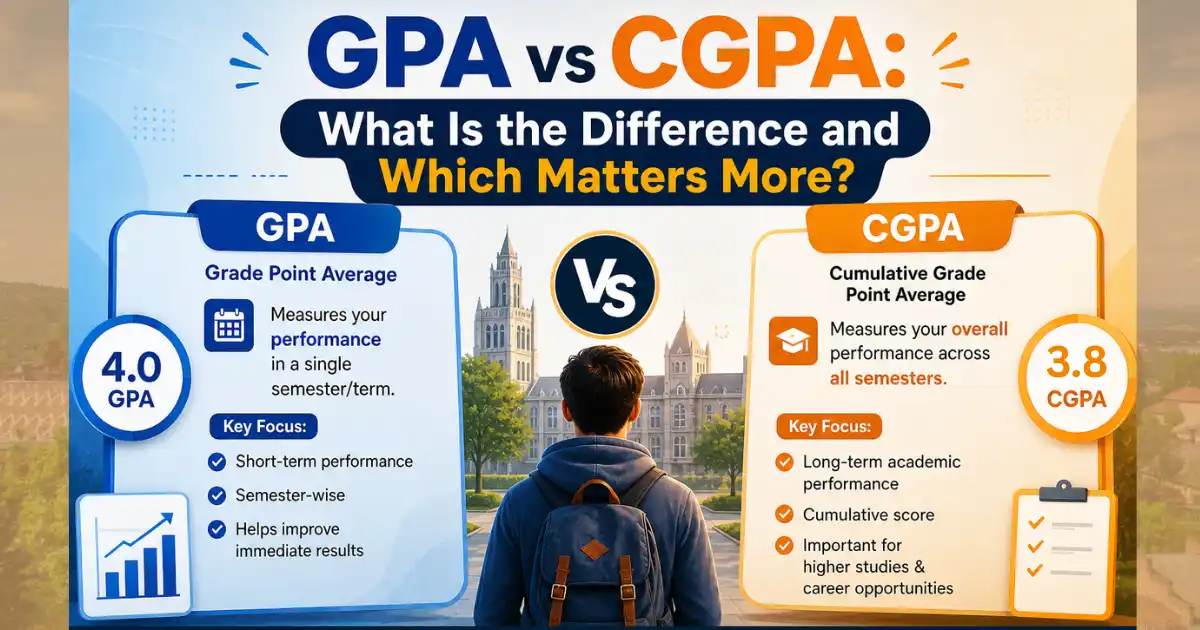
GPA stands for Grade Point Average. It is a numerical representation of a student’s academic performance during a specific period — typically one semester or academic term.
How GPA Is Calculated
GPA is calculated by assigning a grade point value to each letter grade, multiplying it by the number of credit hours for each course, and dividing the total by the total number of credit hours attempted.
Here is the standard US grading scale used to calculate GPA:
| Letter Grade | Grade Points | Percentage Range |
| A+ | 4.0 | 97–100% |
| A | 4.0 | 93–96% |
| A- | 3.7 | 90–92% |
| B+ | 3.3 | 87–89% |
| B | 3.0 | 83–86% |
| B- | 2.7 | 80–82% |
| C+ | 2.3 | 77–79% |
| C | 2.0 | 73–76% |
| D | 1.0 | 60–69% |
| F | 0.0 | Below 60% |
Example Calculation: Suppose you took 3 courses in a semester:
- Mathematics (3 credits): A = 4.0 grade points
- English (3 credits): B = 3.0 grade points
- Physics (4 credits): B+ = 3.3 grade points
GPA = [(3 x 4.0) + (3 x 3.0) + (4 x 3.3)] / (3 + 3 + 4) = [12 + 9 + 13.2] / 10 = 34.2 / 10 = 3.42
Key Characteristics of GPA
- Reflects performance in a single term or semester
- Resets or recalculates for each new semester
- Useful for spotting trends in performance over time
- Can go up or down depending on each semester’s results
- Commonly used for academic probation warnings and dean’s list recognition
What Is CGPA?
CGPA stands for Cumulative Grade Point Average. It is the average of all GPA scores earned across every semester of a student’s academic program. Think of CGPA as the big picture, the sum total of your academic performance from day one to graduation.
How CGPA Is Calculated
CGPA is calculated by averaging the GPA of all completed semesters. It is a running total that gets updated at the end of each term.
Formula: CGPA = Sum of (GPA x Credit Hours for each semester) / Total Credit Hours Completed
Continuing the example above:
- Semester 1 GPA: 3.42 (10 credit hours)
- Semester 2 GPA: 3.70 (12 credit hours)
- Semester 3 GPA: 3.20 (11 credit hours)
CGPA = [(3.42 x 10) + (3.70 x 12) + (3.20 x 11)] / (10 + 12 + 11) = [34.2 + 44.4 + 35.2] / 33 = 113.8 / 33 = 3.45
Key Characteristics of CGPA
- Reflects overall academic performance across the entire program
- Continuously updated each semester
- Difficult to raise significantly in the final semesters
- Appears on transcripts and official academic records
- Most commonly used in graduate school applications and job screenings
GPA vs CGPA Comparison
| Feature | GPA | CGPA |
| Full Form | Grade Point Average | Cumulative Grade Point Average |
| Period Covered | Single semester/term | Entire academic program |
| Resets? | Yes, every semester | No, continuously accumulates |
| Best Used For | Short-term performance tracking | Overall academic standing |
| Seen On Transcript? | Sometimes | Always |
| Employer Focus | Rarely highlighted | Primary reference metric |
| Grad School Focus | Secondary | Primary |
| Impacted by One Bad Semester? | Yes, significantly | Less significantly over time |
| Scale | 4.0 (US), 10-point, 5-point | Same scale as GPA |
| International Recognition | Moderate | High |
GPA vs CGPA Difference
1. Time Frame
The most fundamental GPA vs CGPA difference is time. GPA is a snapshot, a photo of your academic life at a specific moment. CGPA is a movie that tells the entire story. If you had a rough first year but performed brilliantly afterward, your CGPA tells that redemption arc more accurately than any single semester GPA.
2. Stability and Predictability
GPA can swing dramatically from semester to semester. A student who scored a 2.5 in one semester and a 4.0 in the next will show both extremes clearly. CGPA, by contrast, smooths these variations. This is why CGPA is considered a more stable and reliable indicator of academic ability.
3. Academic Scale Differences
In the United States, the standard GPA scale runs from 0.0 to 4.0. However, in countries like India, Pakistan, and parts of Europe, institutions use a 10-point CGPA system. This creates challenges when comparing grades internationally, which is why applicants often must convert their CGPA using approved formulas when applying to foreign universities.
4. Weighted vs Unweighted
Some universities and high schools calculate a weighted GPA, which gives more grade points to honors, AP, or advanced courses. Unweighted GPA treats all courses equally. CGPA systems typically maintain the same weighting philosophy consistently throughout a program.
Which One Matters More, GPA or CGPA?
The honest answer: it depends on the context. Here is a practical breakdown of when each metric takes the spotlight.
For Graduate School Admissions
Graduate programs in the US, UK, Canada, and Australia almost universally ask for a CGPA. Admissions committees want to see consistent performance over time, not a single brilliant semester. Most top programs like Harvard, MIT, and Stanford list minimum CGPA requirements (often 3.0 to 3.5 on a 4.0 scale) in their eligibility criteria.
For Job Applications
Most employers ask for your CGPA on application forms, particularly in engineering, finance, consulting, and law. Top firms like McKinsey, Goldman Sachs, and Google have historically screened candidates with minimum CGPA thresholds (typically 3.5 or above). However, this trend is evolving; many companies in 2026 are deprioritizing grades in favor of skills assessments and portfolio work.
For Scholarships
Scholarship committees almost always evaluate CGPA. Merit-based awards require proof of sustained academic excellence, and your CGPA provides exactly that. Single-semester GPAs may be considered as supplementary context but rarely carry the same weight.
For Internal Academic Standing
Within your university, GPA often determines whether you make the dean’s list, are placed on academic probation, or qualify for graduation honors. Different institutions apply different standards:
- Summa Cum Laude: 3.9 to 4.0 CGPA
- Magna Cum Laude: 3.7 to 3.89 CGPA
- Cum Laude: 3.5 to 3.69 CGPA
| Context | GPA or CGPA? | Why? |
| Graduate School | CGPA | Holistic performance required |
| Employment | CGPA | Shows long-term consistency |
| Scholarships | CGPA | Merit based on sustained effort |
| Dean’s List / Honors | GPA (per semester) | Recognizes per-term excellence |
| Academic Probation | GPA (per semester) | Identifies immediate struggles |
| Internship Applications | Either | Depends on employer policy |
How to Improve Your GPA and CGPA in 2026
Short-Term GPA Improvement Strategies
- Prioritize courses with higher credit weights these impact your GPA the most.
- Attend office hours and seek professor feedback early in the semester.
- Use AI-powered study tools and adaptive learning platforms.
- Form study groups for complex subjects like mathematics and sciences.
- Submit assignments early and avoid last-minute cramming.
Long-Term CGPA Recovery Strategies
- Retake courses where you scored poorly, if your institution allows grade replacement.
- Take lighter course loads in difficult semesters to avoid GPA dips.
- Focus on grade trends a rising CGPA from year 2 to year 4 tells a positive story.
- Seek academic counseling early if you notice your CGPA dropping below target thresholds.
- Choose electives strategically, courses where you can excel, to boost your CGPA.

GPA and CGPA in the Global Context
One critical challenge with GPA and CGPA is that there is no universal standard. Different countries use different scales, and converting between them is not always straightforward.
| Country / System | Scale Used | Equivalent to US 3.0 GPA |
| United States | 4.0 scale | 3.0 / 4.0 |
| India (many universities) | 10-point CGPA | 7.5 / 10 |
| Pakistan (HEC system) | 4.0 scale | 2.8 / 4.0 |
| United Kingdom | Degree Classification | Upper Second Class (2:1) |
| Germany | 5-point (reverse) | 2.0 / 5.0 |
| Australia | 7-point scale (GPA) | 4.2 / 7.0 |
When applying to international programs, always use the institution’s official grade conversion tool or ask for a World Education Services (WES) evaluation to ensure your CGPA is assessed accurately.
Common Myths About GPA and CGPA
Myth 1: A Low CGPA Means You Cannot Get a Good Job
False. While a high CGPA helps in initial screenings, many employers in 2026 — especially in tech and creative industries — evaluate candidates on skills, projects, and interviews. Companies like Apple, IBM, and Deloitte have publicly stated they no longer require minimum GPA/CGPA cutoffs for certain roles.
Myth 2: GPA and CGPA Are the Same Thing
False. As this article has explained in detail, they differ in scope, calculation, and application. Using them interchangeably can cause confusion in academic and professional settings.
Myth 3: You Cannot Recover from a Low CGPA
Not entirely true. While a low CGPA in early semesters is hard to completely reverse, a strong upward trend can still signal growth to graduate schools and employers. Context and narrative matter.
Myth 4: A 4.0 GPA Automatically Means a 4.0 CGPA
False. Even if you score a 4.0 in your most recent semester, your CGPA is the weighted average of all semesters, not just the latest one.
Conclusion
The GPA vs CGPA difference comes down to perspective: one measures where you are right now, and the other measures the entire journey. Both are important, but for most high-stakes academic and career decisions in 2026, CGPA takes the leading role.
Understanding how each is calculated, what impacts them, and where they are evaluated gives you a strategic advantage. Whether you are aiming for a top graduate program, competing for a scholarship, or building a career at a prestigious firm, your CGPA tells your most complete academic story.
Start tracking both metrics from your very first semester. Make informed decisions about course selection, workload, and study habits. And remember, while grades matter, they are one chapter of a much larger story about your skills, growth, and potential.