
How AP and IB Classes Boost Your Weighted GPA: A Complete College Admissions Guide
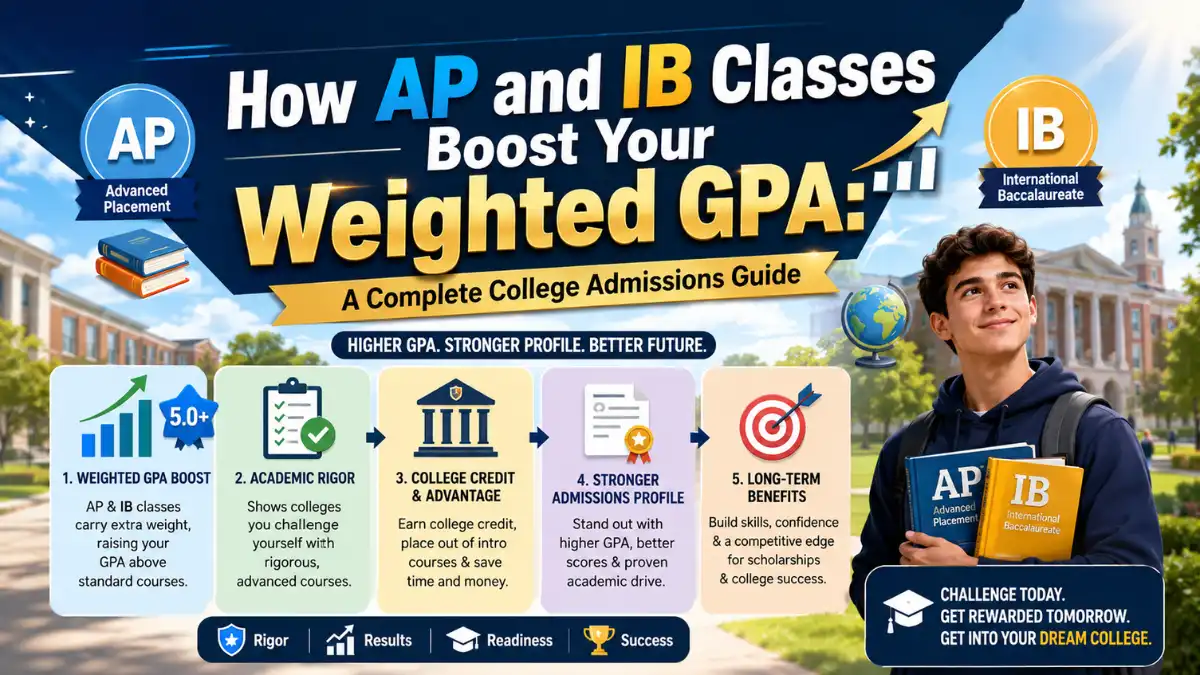
Every high school student dreams of standing out in college admissions. But in 2026, with record application volumes at top universities and acceptance rates at historic lows, the question isn’t just how good your GPA is, it’s how hard you pushed yourself to earn it.
Advanced Placement (AP) and International Baccalaureate (IB) classes are two of the most powerful academic tools available to high schoolers. Beyond mastering challenging material, these courses directly impact your weighted GPA, one of the most scrutinized numbers in any college application.
In this guide, we’ll break down exactly how AP and IB classes boost your weighted GPA, and what college admissions officers really look for.
Understanding Weighted vs. Unweighted GPA
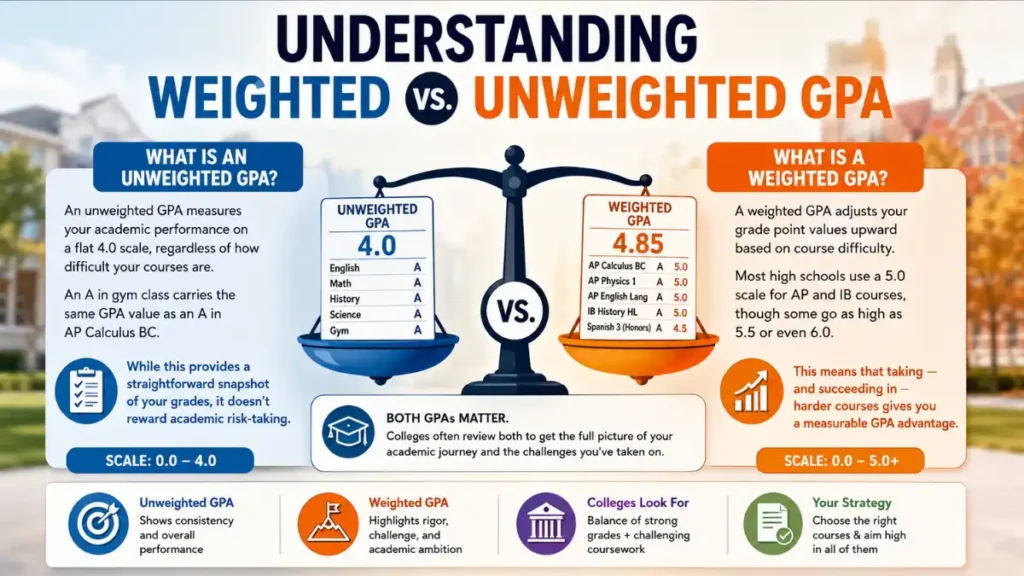
What Is an Unweighted GPA?
An unweighted GPA measures your academic performance on a flat 4.0 scale, regardless of how difficult your courses are. An A in gym class carries the same GPA value as an A in AP Calculus BC. While this provides a straightforward snapshot of your grades, it doesn’t reward academic risk-taking.
What Is a Weighted GPA?
A weighted GPA adjusts your grade point values upward based on course difficulty. Most high schools use a 5.0 scale for AP and IB courses, though some go as high as 5.5 or even 6.0. This means that taking and succeeding in harder courses gives you a measurable GPA advantage.
| Course Type | Grade Earned | Unweighted Points | Weighted Points |
| Standard | A | 4.0 | 4.0 |
| Honors | A | 4.0 | 4.5 |
| AP / IB | A | 4.0 | 5.0 |
| AP / IB | B | 3.0 | 4.0 |
| AP / IB | C | 2.0 | 3.0 |
Table 1: Weighted vs. Unweighted GPA Comparison by Course Type
To see how your current course load translates into a weighted or unweighted GPA, try using this high school GPA calculator. It lets you input different course levels and grades to model your exact scenario.
How AP Classes Boost Your Weighted GPA
The AP GPA Boost
AP courses are designed by the College Board and are among the most widely recognized advanced courses in American high schools. Nearly 40% of U.S. high school graduates take at least one AP exam before graduating, according to College Board data.
Here’s what the GPA boost looks like in practice:
- A student who earns a B (3.0) in AP Biology receives 4.0 weighted GPA points for that course, the same as an A in a regular class.
- A student who earns an A (4.0) in AP Chemistry receives 5.0 weighted GPA points a full point above the standard maximum.
- Taking five AP classes and earning Bs in all of them could yield a weighted GPA of 4.0, even though the unweighted GPA would be 3.0.
Which AP Classes Have the Most Impact?
Not all AP classes are created equal in the eyes of colleges. Admissions officers evaluate the rigor of your course selection relative to what your school offers. The most impactful AP courses include:
- AP Calculus AB or BC: signals math readiness for STEM fields
- AP English Language and Composition: demonstrates strong analytical writing skills
- AP Biology, Chemistry, or Physics: essential for pre-med and engineering tracks
- AP US History or World History: shows depth in humanities and critical thinking
- AP Computer Science Principles or A: increasingly valued for technology-oriented programs
AP Exam Scores: A Separate but Related Metric
Your AP exam score (on a scale of 1 to 5) is separate from your weighted GPA calculation, but it remains highly relevant to college admissions. Scoring a 3, 4, or 5 demonstrates that you didn’t just take a hard class — you mastered it. Many colleges also offer college credit for scores of 3 or higher, potentially saving thousands in tuition.
How IB Classes Impact Your Weighted GPA
Understanding the IB Diploma Programme
The International Baccalaureate Diploma Programme (IBDP) is a rigorous two-year curriculum for students in grades 11 and 12. IB students take courses across six subject groups, complete an extended essay, participate in a Theory of Knowledge course, and log creativity, activity, and service (CAS) hours.
IB courses are categorized into two levels:
- Standard Level (SL): Slightly less intensive, typically weighted similarly to AP or Honors courses
- Higher Level (HL): Equivalent to introductory college coursework; usually given the maximum weighted GPA boost (5.0 on a 5.0 scale)
IB GPA Weighted: How Schools Calculate It
Since IB grading uses a 1-7 scale internally, high schools must convert IB grades to the GPA system. The conversion typically looks like this:
| IB Grade | Letter Grade Equivalent | Weighted GPA Points (HL) |
| 7 | A+ | 5.0 |
| 6 | A | 5.0 |
| 5 | B+ | 4.5 |
| 4 | B | 4.0 |
| 3 | C | 3.0 |
| 2 | D | 2.0 |
Table 2: IB Grade to Weighted GPA Conversion (Higher Level Courses)
Calculating your IB GPA manually can get complicated with HL vs. SL distinctions. Using an online high school GPA calculator that supports weighted inputs can simplify this process significantly.
AP vs. IB: Which Impacts More?
Both AP and IB courses offer meaningful weighted GPA benefits, but the right choice depends on your school’s offerings, your academic goals, and your learning style.
| Factor | AP | IB |
| GPA Weight (max) | 5.0 | 5.0 (HL) |
| Course flexibility | Pick individual courses | Full diploma or certificates |
| International recognition | Primarily USA | Globally recognized |
| Workload | Moderate to high | Very high (diploma) |
| College credit opportunity | Yes (score 3+) | Yes (HL score 5+) |
| Admissions signal | Course rigor | Global perspective + rigor |
Table 3: AP vs. IB — Side-by-Side Comparison
The verdict: if your school offers IB, completing the full diploma programme is often viewed as slightly more prestigious due to its comprehensive nature. However, a strong AP course load with excellent exam scores is equally competitive at elite universities.
What College Admissions Officers Actually Look For
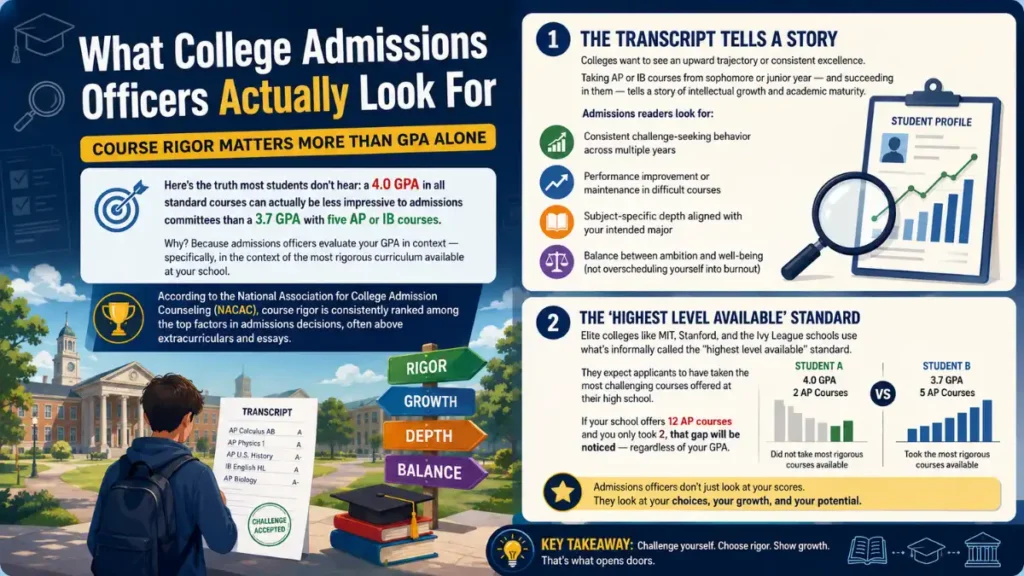
Course Rigor Matters More Than GPA Alone
Here’s the truth most students don’t hear: a 4.0 GPA in all standard courses can actually be less impressive to admissions committees than a 3.7 GPA with five AP or IB courses. Why? Because admissions officers evaluate your GPA in context, specifically, in the context of the most rigorous curriculum available at your school.
According to the National Association for College Admission Counseling (NACAC), course rigor is consistently ranked among the top factors in admissions decisions, often above extracurriculars and essays.
The Transcript Tells a Story
Colleges want to see an upward trajectory or consistent excellence. Taking AP or IB courses in sophomore or junior year and succeeding in them tells a story of intellectual growth and academic maturity. Admissions readers look for:
- Consistent challenge-seeking behavior across multiple years
- Performance improvement or maintenance in difficult courses
- Subject-specific depth aligned with your intended major
- Balance between ambition and well-being (not overscheduling yourself into burnout)
The ‘Highest Level Available’ Standard
Elite colleges like MIT, Stanford, and the Ivy League schools use what’s informally called the ‘highest level available’ standard. They expect applicants to have taken the most challenging courses offered at their high school. If your school offers 12 AP courses and you only took 2, that gap will be noticed regardless of your GPA.
Practical Tips to Maximize Your Weighted GPA with AP and IB
- Start with one or two AP or IB courses in 9th or 10th grade to build habits before ramping up.
- Choose courses strategically to align AP/IB selections with your intended college major.
- Don’t sacrifice GPA for quantity: five Bs in AP classes is better than five Cs in IB HL courses.
- Many AP students use the summer productively to self-study for exams in subjects they didn’t take in class.
- Track your GPA regularly using a reliable calculator so you can course-correct early.
- Balance your schedule to avoid burnout. Colleges look for sustained performance, not one strong semester.
- Consult your school counselor about which AP/IB courses are recommended, given your grade level.
Conclusion
Your weighted GPA is more than just a number; it’s a reflection of how you’ve chosen to challenge yourself throughout high school. AP and IB classes are among the most effective tools for boosting that number, signaling academic readiness to colleges, and potentially earning credit before you even set foot on campus.
The key takeaway: take the most rigorous courses available at your school, perform as well as you can in them, and use strategic planning tools to stay on track. Whether you’re a sophomore mapping out your next two years or a junior fine-tuning your senior schedule, understanding how weighted GPA works gives you a genuine competitive advantage.
Use a high school GPA calculator to model different scenarios. What happens to your weighted GPA if you take four AP classes next year? What if you earn Bs instead of As in your IB HL courses? The answers will help you make smarter academic decisions and put your best foot forward in the college admissions process.