
Pakistan Grading System 2026: The Complete Guide to CGPA & University Grading
If you’re a student in Pakistan, you’ve probably run into two very different worlds of grading in your academic life. In school and college, you got a percentage and a “division.” In university, suddenly everyone is talking about GPA, CGPA, and grade points on a 4.0 scale. It’s confusing — especially when a scholarship form asks for your percentage, but your transcript only shows a CGPA.
This guide breaks down exactly how the Pakistan grading system works in 2026: the official Higher Education Commission (HEC) CGPA framework, the letter-grade scale used by most universities, how to calculate your own CGPA, and how to convert it to a percentage when you need one. Where it’s useful, we’ve linked to free calculators so you can check your own numbers in seconds instead of doing the math by hand.
How Grading Works in Pakistan: A Quick Overview
Pakistan actually uses two separate grading systems depending on your level of education:
- School and college (Matric, O/A Levels, FSc/FA/ICS): Boards typically report a percentage of marks, which is then translated into a division — 1st, 2nd, or 3rd — and, increasingly, a letter grade.
- University (undergraduate and graduate degrees): Almost all HEC-recognized universities now use a semester-based Cumulative Grade Point Average (CGPA) system, following guidelines set by the Higher Education Commission of Pakistan.
This shift happened because HEC pushed universities toward a standardized semester system, moving away from the older annual/percentage-based exams that boards and some older-style institutions still use. The goal was to bring Pakistani degrees closer to international academic standards so that transcripts are easier to evaluate abroad and across institutions.
What Is the HEC CGPA System?
The CGPA (Cumulative Grade Point Average) is the standardized measure the Higher Education Commission uses to track a student’s overall academic performance across a degree program. Instead of averaging raw marks, each course grade is converted into a grade point, weighted by that course’s credit hours, and averaged out.
The formula HEC-affiliated universities use is:
GPA = Σ (Grade Point × Credit Hours) ÷ Σ (Credit Hours)
Your CGPA is simply the same calculation applied across all the semesters you’ve completed so far, not just one term. A typical Pakistani undergraduate semester carries 15–18 credit hours, and a four-year BS degree usually totals somewhere around 130–140 credit hours.
Rather than working this out by hand every semester, most students just plug their grades and credit hours into a dedicated tool — our Pakistan University CGPA Calculator does this automatically and supports the grading formulas used at COMSATS, NUST, UMT, UET Lahore, FAST-NU, GIKI, and other major institutions.
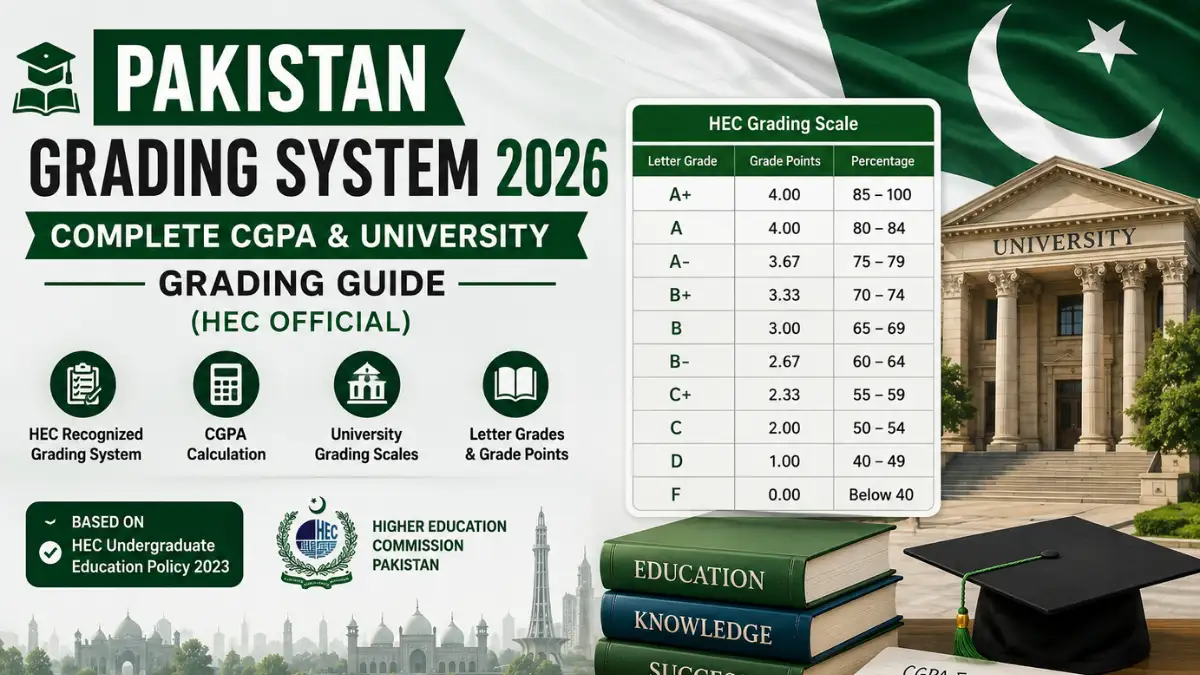
The Pakistan University Grading Scale (HEC 4.0 Table)
Most universities in Pakistan follow the HEC-recommended 4.0 scale, though the exact percentage cutoffs for each letter grade can vary slightly from one university to another (a small number of institutions, along with some MPhil/PhD programs, use a 5.0 scale instead). The commonly used ranges look like this:
| Letter Grade | Marks (%) | Grade Point |
|---|---|---|
| A+ / A | 85% and above | 4.00 |
| A- | 80–84% | 3.70 |
| B+ | 75–79% | 3.30 |
| B | 70–74% | 3.00 |
| B- | 65–69% | 2.70 |
| C+ | 61–64% | 2.30 |
| C | 58–60% | 2.00 |
| C- | 55–57% | 1.70 |
| D | 50–54% | 1.00 |
| F | Below 50% | 0.00 |
Important: These bands are the general HEC-style benchmark used by most institutions, but they are not identical everywhere. For example, some universities set A = 4.0 starting at 80% rather than 85%. Always check your own university’s official grading policy in your student handbook, since your transcript will be based on that exact table — not a generic one.
How to Calculate Your CGPA (Step by Step)
Here’s a simplified example of how the math works for one semester:
- List each course, its credit hours, and the letter grade you received.
- Convert each letter grade to its grade point using your university’s scale.
- Multiply grade point × credit hours for each course.
- Add up all those totals, then divide by the total credit hours for the semester.
Example:
| Course | Credit Hours | Grade | Grade Point | GP × CH |
|---|---|---|---|---|
| Calculus I | 3 | A | 4.0 | 12.0 |
| Programming Fundamentals | 4 | B+ | 3.3 | 13.2 |
| English Composition | 3 | A- | 3.7 | 11.1 |
| Islamic Studies | 2 | B | 3.0 | 6.0 |
Total credit hours = 12, Total (GP × CH) = 42.3
Semester GPA = 42.3 ÷ 12 = 3.53
Once you have GPAs for multiple semesters, your CGPA is calculated the same way, using the combined credit hours and grade points across every semester you’ve completed. If you’d rather skip the manual math (and the risk of a calculation error on something this important), the Pakistan CGPA Calculator does the weighting for you instantly and lets you download a PDF summary.
CGPA to Percentage Conversion (HEC Formula)
Universities issue CGPA, but many government job applications (PPSC, FPSC), scholarship boards, and some foreign credential evaluators still ask for a percentage. HEC has provided guidance for this conversion, and the simplest widely used version for a standard 4.0 scale is:
Percentage = (CGPA ÷ 4.0) × 100
So a CGPA of 3.5 converts to roughly 87.5%, and a CGPA of 3.0 converts to about 75%.
For more precision, some universities and evaluators apply a piecewise formula that adjusts slightly at the higher end of the scale (since very high CGPAs compress differently than the straight linear formula suggests). If you need an exact figure for an official form, it’s worth generating it through our CGPA to Percentage Calculator, which applies the correct conversion logic rather than a flat estimate — and always double check against your university’s own conversion certificate if one is required, since some institutions print their own formula directly on the transcript.
Minimum CGPA Requirements in Pakistan
CGPA thresholds show up in a few different places during a student’s academic journey:
- Minimum CGPA to graduate: Most undergraduate programs (BS, BBA, BCom) require a minimum cumulative 2.0 CGPA to be awarded the degree.
- Good standing / avoiding probation: Falling below a set CGPA (often 1.5–2.0, depending on the university) can put a student on academic probation.
- Dean’s Honor List / Merit lists: Typically requires 3.5 CGPA or higher in a given semester.
- Scholarships: Most HEC and provincial scholarship programs, along with need-based schemes like PEEF, set a minimum of 3.0 CGPA, with more competitive scholarships requiring 3.5+.
- Jobs and graduate admissions: Many employers and MS/PhD programs set an informal or formal cutoff around 3.0 CGPA (roughly 75%).
For a full breakdown of scholarship-specific CGPA cutoffs (HEC, PEEF, Army, and others), see our detailed guide: Minimum CGPA for Scholarships in Pakistan.
Do All Pakistani Universities Use the Same CGPA Scale?
Not exactly — and this is where a lot of confusion comes from. While HEC sets the overall framework, individual universities are given some flexibility in implementation:
- COMSATS, NUST, FAST-NU, UMT, GIKI: Follow the standard HEC 4.0 scale closely.
- University of Karachi (UoK): Uses the same underlying HEC 4.0 methodology but labels the cumulative score CGPR (Cumulative Grade Point Ratio) instead of CGPA.
- UET Lahore and some engineering universities: Apply slightly different percentage cutoffs for each letter grade compared to other institutions.
- Older / affiliated colleges under provincial boards: Some may still report results as a percentage and division rather than CGPA, particularly at the intermediate (FSc/FA) level.
Because of these small differences, the safest approach is always to check your specific university’s official grading regulations — usually published on the registrar’s or academics section of the university website — rather than assuming every school uses an identical table.
The Older Division System (Matric, FSc, and Legacy Grading)
Before CGPA became standard at the university level, and still today at the school/college level in many boards, results were reported using percentage-based divisions:
- 1st Division: 60% and above
- 2nd Division: 45–59%
- 3rd Division: 33–44%
Following education reforms in recent years, several boards have moved toward letter grades and adjusted passing thresholds, but the division system is still commonly referenced for Matric and Intermediate (FSc/FA) results, and it’s still what many older degree holders will see on their transcripts.
Pakistan’s Grading System vs. the US and UK
If you’re applying abroad, it helps to know how Pakistan’s system maps to other countries:
- United States: Also uses a 4.0 GPA scale, similar in structure to Pakistan’s HEC system, though US universities tend to weigh continuous assessment (assignments, quizzes, participation) more heavily than final exams alone.
- United Kingdom: Uses a classification system instead of GPA — First Class (70%+), Upper Second/2:1 (60–69%), Lower Second/2:2 (50–59%), and Third Class (40–49%). This is quite different from Pakistan’s hybrid GPA/percentage approach, so credential evaluators typically use official conversion tables rather than a simple formula.
HEC Degree Attestation and Your CGPA
If you’re planning to work, study, or immigrate abroad, your Pakistani degree generally needs to be attested by HEC before it’s accepted internationally. The attestation process verifies your original degree and transcript (including your CGPA and division), and processing usually takes 7–21 working days when applied for through the HEC e-office portal. Since your CGPA and its percentage equivalent are what most international credential evaluators actually look at, it’s worth confirming your official numbers are accurate before you submit anything.
Final Thoughts
Pakistan’s shift from a purely percentage-based system to a standardized HEC CGPA framework has made it easier to compare academic performance across universities and, increasingly, across borders. That said, small differences between institutions still exist, so always verify your own university’s exact grading table before relying on general benchmarks.
If you want to skip the manual math entirely, you can calculate your own CGPA, convert it to a percentage, or check where you stand against scholarship cutoffs using our free tools:
- Pakistan University CGPA Calculator
- CGPA to Percentage Calculator
- Minimum CGPA for Pakistan Scholarships
- Grade Calculator
Sources & Further Reading
- Higher Education Commission of Pakistan — Semester/Grading Guidelines: hec.gov.pk/site/sg
- HEC Undergraduate Education Policy (V 1.1): hec.gov.pk/english/policies/Pages/UGEP.aspx
- HEC Policy Guidelines for Implementation of Uniform Semester System in Higher Education Institutions of Pakistan
- GPA Calculator Collage — Pakistan University GPA Calculator
Frequently Asked Questions
This article is for general educational guidance. Grading tables, minimum CGPA rules, and conversion formulas vary by institution — always confirm exact figures with your university’s registrar or official transcript before using them for official applications.