
CGPA to Percentage: Formula, Examples, and Why There’s No Single Answer
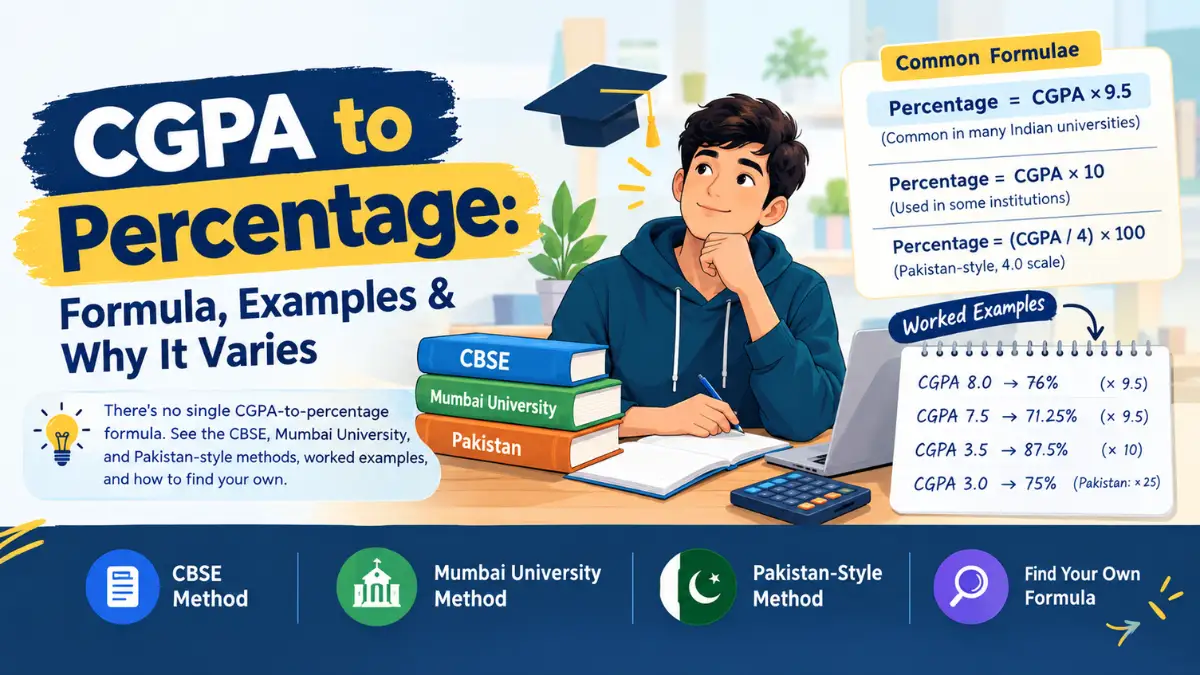
There is no single formula that converts CGPA to percentage for every student. The right method depends entirely on which institution issued your CGPA. In India, CBSE uses Percentage = CGPA × 9.5, but this is explicitly labeled an indicative approximation, not an exact conversion, and other Indian universities use entirely different formulas. In Pakistan, universities on a 4.0 scale commonly use Percentage = (CGPA ÷ 4) × 100, but this is not a formula published by a single national regulator, so you should confirm it with your own university. Always check your institution’s official conversion rule before using any number on an application.
Quick facts
| CBSE (India), Class 10 | Percentage = CGPA × 9.5, described as indicative only |
| Mumbai University | Percentage = (CGPA − 0.75) × 10 |
| KTU (Kerala) | Percentage = CGPA × 10 |
| Calcutta University | Percentage = CGPA × 10, in most departments |
| Simple linear (any X-point scale) | Percentage = (CGPA ÷ X) × 100 |
| Common Pakistan practice (4.0 scale) | Percentage = (CGPA ÷ 4) × 100, verify with your university |
| Universal formula that works everywhere | Does not exist |
Why there’s no universal formula
CGPA scales differ by country, board, and even by university within the same country. A CGPA can sit on a 4-point, 5-point, 7-point or 10-point scale, and the same numeral means something different on each. A 3.5 on a 4-point scale is close to the top, while a 3.5 on a 10-point scale is closer to the bottom.
Even on the same 10-point scale, formulas differ between institutions. Mumbai University uses a subtract-then-multiply formula rather than a simple multiplier, while Calcutta University multiplies by 10 rather than 9.5. Two students with an identical CGPA of 8.0 could get different percentages depending on which university issued it. That’s why the only formula you should trust is the one published by the institution that gave you the CGPA.
The CBSE formula, and why it’s only approximate
CBSE’s own circular describes the CGPA-to-marks step as an “indicative equivalence,” giving the formula as 9.5 times the grade point, both for a single subject and for the overall CGPA. The circular does not claim this is exact.
The origin of the 9.5 multiplier is documented in secondary sources as coming from CBSE’s own data. When CBSE assigned the top grade band, A1, to marks from 91 to 100, it reportedly found that students in that band averaged about 95 marks. Dividing 95 by the A1 grade point of 10 gives 9.5, and CBSE applied that same multiplier across the whole scale.
Because 9.5 was derived from one grade band’s average, it is only an approximation elsewhere on the scale. A student with a CGPA of 8.0 is estimated at 76%, but that does not mean every student with that CGPA scored exactly 76%; it means their marks likely fall within the B1 band, which spans a range of scores. CBSE does not print this percentage on the official marksheet. It exists only as a reference for students who need a percentage for a college application or scholarship form.
Worked example 1: CBSE-style 10-point scale
Suppose a Class 10 student has these grade points in five main subjects.
| Subject | Grade | Grade point |
|---|---|---|
| English | A2 | 9 |
| Mathematics | A1 | 10 |
| Science | B1 | 8 |
| Social Science | A2 | 9 |
| Second Language | B1 | 8 |
| Total | 44 |
Step 1: Find the CGPA. CGPA = 44 ÷ 5 = 8.8.
Step 2: Apply the CBSE indicative formula. Percentage = 8.8 × 9.5 = 83.6%.
This 83.6% is an estimate, not the student’s exact aggregate. If a form asks for the exact percentage, the more accurate method is to add the actual marks scored in each subject, divide by the maximum possible marks, and multiply by 100.
Worked example 2: a university-specific formula
Suppose a student at a university that uses Percentage = (CGPA − 0.75) × 10 has a CGPA of 8.2.
Percentage = (8.2 − 0.75) × 10 = 7.45 × 10 = 74.5%.
Using the CBSE-style formula instead on the same CGPA would give 8.2 × 9.5 = 77.9%, a difference of more than 3 percentage points. This is exactly why you cannot borrow a formula from a different institution’s rules and expect an accurate result.
Worked example 3: a simple linear scale
Many universities outside the CBSE system, especially on 4-point or 5-point CGPA scales, use a straightforward linear formula:
Percentage = (CGPA ÷ maximum CGPA on your scale) × 100On a 4-point scale, a CGPA of 3.2 converts as:
Percentage = (3.2 ÷ 4) × 100 = 80%.
On a 10-point scale, the same formula treats a CGPA of 8.0 as:
Percentage = (8.0 ÷ 10) × 100 = 80%.
Notice this simple linear approach gives a different result from CBSE’s 9.5 multiplier on a 10-point scale. At CGPA 8.0, the linear formula gives 80%, while CBSE’s indicative formula gives 76%. Neither is “wrong,” they are simply different institutional rules, which is the whole point of this guide.
Pakistan: what to check before converting
Pakistani universities that use a 4.0 scale commonly apply Percentage = (CGPA ÷ 4) × 100 informally, and some private guides describe this as an HEC-aligned method. However, this guide could not locate a single HEC circular that mandates one universal CGPA-to-percentage formula for all universities. Some Pakistani institutions also publish detailed marks-to-grade-point band tables that convert in the opposite direction, from marks to CGPA, rather than a formula for converting CGPA back to a percentage.
Because of this, treat any “HEC formula” you find online as a common convention, not a confirmed regulation, until your own university’s examination department confirms it. See our Pakistan grading system guide for what individual universities publish.
When you should use exact marks instead
Whenever the option exists, calculating your percentage directly from your actual marks is more accurate than converting from CGPA:
Percentage = (total marks obtained ÷ total marks possible) × 100This sidesteps every conversion formula entirely, since it uses the underlying marks rather than a grade-based estimate. If your marksheet lists both marks and CGPA, use the marks for anything where precision matters, such as a scholarship cut-off measured in whole percentage points.
Going the other way
Sometimes you have a percentage and need a CGPA instead, for example if an older transcript only lists marks and a new application form asks for CGPA. The method mirrors whichever formula your institution uses.
Under the CBSE-style approach, you reverse the multiplication: CGPA = Percentage ÷ 9.5. A percentage of 76 gives 76 ÷ 9.5 = 8.0. Under a simple linear 10-point scale, the formula is CGPA = (Percentage ÷ 100) × 10, so 76% becomes 7.6, a different result from the CBSE-style calculation. As with the forward conversion, the two methods are not interchangeable, and neither is “more correct” than the other; they simply belong to different institutional systems.
If you are filling in a form that asks for CGPA but your only record is a percentage from a percentage-based board, check whether the receiving organization has its own required conversion. Some scholarship and visa applications specify the exact formula they want you to use, which removes the guesswork entirely.
Why this matters for scholarships and job applications
Many scholarship committees, graduate programs, and employers ask for a percentage because it’s a familiar unit, even when the applicant’s transcript is issued in CGPA. Submitting a self-converted percentage without stating the formula you used can create confusion if the reviewer expects a different one. Where possible, note which formula you used, for example “8.2 CGPA (converted using CBSE’s indicative 9.5 formula) equals approximately 77.9%,” so the reviewer can judge the number in context rather than assuming it’s an official score.
Common mistakes
- Using the “multiply by 9.5” rule outside CBSE: This formula is specific to CBSE’s grade bands and not a global 10-point standard.
- Treating an indicative percentage as an official one: CBSE explicitly calls its converted number an approximation.
- Applying an Indian university’s formula to a Pakistani CGPA, or vice versa: The scales and formulas are unrelated.
- Assuming every 10-point scale uses the same multiplier: Calcutta University’s ×10 and CBSE’s ×9.5 both operate on 10-point scales but give different answers.
- Skipping the university’s own published rule: When your institution has published a formula, such as Mumbai University’s subtract-then-multiply method, use that exact one.
- Rounding your CGPA before converting: Convert using your unrounded CGPA and round only the final percentage.
How to find your own institution’s formula
- Check your marksheet or transcript for a printed formula or footnote.
- Search your university’s examination department or controller of examinations page for a “CGPA to percentage” notice.
- If nothing is published, contact the examination office directly rather than relying on an online calculator.
- For scholarship or job applications, check whether the receiving organization has its own required conversion method, since some override your university’s formula with their own.
Try the calculator
Percentage to CGPA and CGPA to percentage tools are most useful once you know your institution’s formula. Use our College GPA Calculator for GPA and CGPA math, and the Pakistan University GPA Calculator if you study in Pakistan.
Related guides
- What Is GPA? Complete Guide to Grade Point Average
- GPA vs CGPA: Key Differences
- What SGPA and CGPA Mean, and How They Differ
- Pakistan Grading System and CGPA Guide
- GPA Scale: Letter Grades, Grade Points, and Percentages