
Percentage to CGPA: Formula, Examples, and Why the Answer Depends on Your Institution
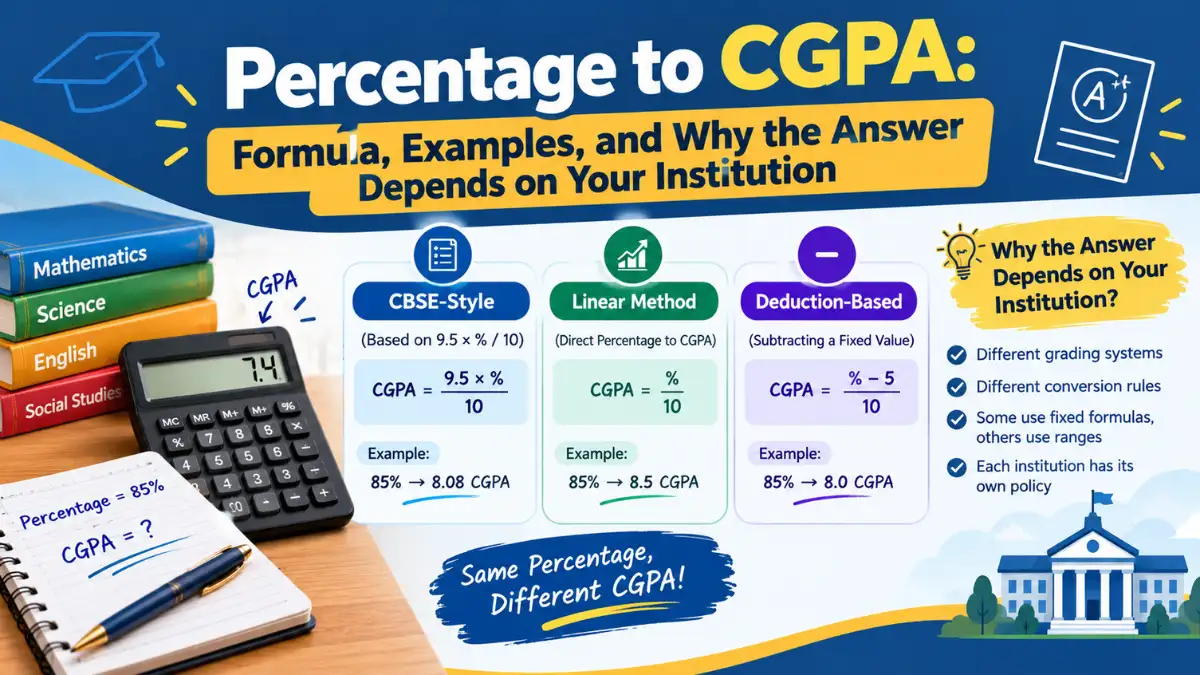
Converting a percentage into CGPA is the reverse of converting CGPA into a percentage, and it has the same problem: there is no single formula that works for every student. Under CBSE’s own indicative method, CGPA = Percentage ÷ 9.5. Under a simple linear 10-point scale, CGPA = (Percentage ÷ 100) × 10. Under the formula some engineering universities use, the calculation is CGPA = (Percentage ÷ 10) + 0.75. These give different answers for the same percentage, so the only reliable method is the one published by the institution or organization that will use your CGPA.
Quick facts
| CBSE-style (10-point, indicative) | CGPA = Percentage ÷ 9.5 |
| Simple linear (any X-point scale) | CGPA = (Percentage ÷ 100) × X |
| Deduction-based (some engineering universities) | CGPA = (Percentage ÷ 10) + 0.75 |
| Letter-grade mapping | Convert percentage to a letter grade band first, then to that band’s grade point |
| Common Pakistan practice (4.0 scale) | CGPA = (Percentage ÷ 100) × 4, verify with your university |
| Universal formula that works everywhere | Does not exist |
Why you might need this conversion
Most students go from CGPA to percentage, not the other way around, but percentage-to-CGPA comes up in a few real situations:
- Older marksheets show only percentage, and a newer application form asks for CGPA.
- You’re comparing your school-leaving percentage against a university’s minimum CGPA requirement.
- A scholarship or job portal’s online form only accepts a CGPA field, even though your transcript reports marks.
In every case, the safest approach is to find out which formula the receiving form or institution expects, rather than picking one at random.
The CBSE-style formula, reversed
CBSE’s own circular gives the forward conversion as Percentage = 9.5 × grade point (or CGPA). To reverse it, divide by 9.5 instead of multiplying:
CGPA = Percentage ÷ 9.5Worked example. Suppose your marksheet shows an aggregate of 78%.
CGPA = 78 ÷ 9.5 = 8.21 (rounded to two decimals).
This reversed formula carries the same caveat as the original. CBSE’s 9.5 multiplier was derived from the average marks of students in one grade band, so it approximates a relationship between grade points and marks. Using it in reverse gives you an estimated CGPA, not a figure CBSE would print on a certificate, because CBSE reports grades and CGPA directly rather than deriving them from your percentage.
The simple linear formula
Many universities outside the CBSE system use a plain linear relationship between percentage and CGPA, regardless of whether the scale is out of 4, 5, 7 or 10:
CGPA = (Percentage ÷ 100) × maximum CGPA on your scaleWorked example on a 10-point scale. A percentage of 82% converts as:
CGPA = (82 ÷ 100) × 10 = 8.2.
Worked example on a 4-point scale. The same 82% on a 4-point scale converts as:
CGPA = (82 ÷ 100) × 4 = 3.28.
Notice this simple approach gives a different 10-point result (8.2) from the CBSE-style reversed formula on the same percentage (82 ÷ 9.5 = 8.63). Neither is more “correct” in general. They are answers to two different institutional questions.
The deduction-based formula
Some engineering universities in India use a formula that first subtracts a constant before scaling. One version, reported for a large technical university, converts CGPA to percentage as Percentage = (CGPA − 0.75) × 10. Reversing that formula gives:
CGPA = (Percentage ÷ 10) + 0.75Worked example. A percentage of 77.5% converts as:
CGPA = (77.5 ÷ 10) + 0.75 = 7.75 + 0.75 = 8.5.
One detail worth flagging: some universities have reportedly changed which formula applies depending on the student’s admission year or curriculum scheme, with older schemes using the deduction method and newer schemes using a direct multiplier instead. If your university has changed its grading scheme over time, check which version applies to your specific batch, not just your university’s name.
Worked example: comparing three formulas side by side
Suppose three students each report a percentage of 85%, but their target CGPA scale and institution’s formula differ.
| Formula | Calculation | Resulting CGPA (10-point scale unless noted) |
|---|---|---|
| CBSE-style (÷ 9.5) | 85 ÷ 9.5 | 8.95 |
| Simple linear (÷ 100 × 10) | (85 ÷ 100) × 10 | 8.50 |
| Deduction-based (÷ 10 + 0.75) | (85 ÷ 10) + 0.75 | 9.25 |
| Simple linear, 4-point scale | (85 ÷ 100) × 4 | 3.40 |
The same 85% produces a 10-point CGPA anywhere from 8.50 to 9.25, depending only on which formula applies. That range is wide enough to change whether a student clears an 8.5 or 9.0 CGPA cut-off for a scholarship or an admission shortlist. This is the clearest illustration of why picking the right formula matters more than doing the arithmetic correctly.
Pakistan: what to check before converting
Universities in Pakistan that grade on a 4.0 scale sometimes use a straightforward linear conversion, CGPA = (Percentage ÷ 100) × 4, when a form or scholarship application asks for CGPA and the student only has a percentage on hand. As with the reverse conversion covered in our CGPA to percentage guide, this guide could not confirm a single HEC circular that mandates this formula for every university. Treat it as a common convention rather than a fixed national rule, and confirm the expected method with your university’s examination office or with the organization requesting the CGPA.
When to avoid converting altogether
If you have access to your actual subject-wise marks, in many cases it is better to calculate your real CGPA directly from your grades rather than estimating it from an aggregate percentage:
- Convert each subject’s percentage to that subject’s grade, using your institution’s own marks-to-grade table.
- Convert each grade to its grade point, again using your institution’s own table.
- Average the grade points, weighted by credit hours if your institution weights them.
This route uses your actual grade points rather than a formula that estimates them from a single overall percentage, so it is more accurate whenever the underlying subject-wise data is available.
What a converted CGPA does and doesn’t prove
A converted CGPA can help you gauge roughly where you stand against a stated cut-off, but it does not carry the same weight as an official transcript figure. Admissions committees and employers who explicitly request CGPA are usually prepared to accept a percentage instead if you explain the conversion, or they may run the conversion themselves using their own preferred formula. Where a specific numeric cut-off decides eligibility, such as a scholarship that requires a CGPA of 8.0 or above, a difference of a few tenths between formulas can be the difference between qualifying and not. In those cases, contact the organization and ask which conversion method they use, rather than submitting a self-calculated number and hoping it matches their internal method.
Common mistakes
- Reversing the wrong formula: If your target institution uses a deduction-based method, dividing by 9.5 instead will give you the wrong CGPA.
- Assuming a linear relationship always applies: Deduction-based and CBSE-style formulas are not linear in the same way, and the results diverge as the percentage gets higher or lower.
- Ignoring scheme or batch changes: Some universities apply different formulas to different admission years, so a friend’s conversion from an earlier year may not apply to you.
- Treating an estimated CGPA as an official one: Unless your institution issues CGPA directly, a converted number is an estimate for reference, not a substitute for your official transcript.
- Applying an Indian formula to a Pakistani percentage, or vice versa: The scales, grade bands, and formulas are unrelated between systems.
- Rounding too early: Carry at least two decimal places through the calculation and round only the final CGPA.
How to find the right formula for your situation
- Check whether the form or institution asking for CGPA has published its own required conversion method.
- If you’re converting your own percentage into your own institution’s CGPA scale, check your marksheet, student handbook, or examination department page for a published formula.
- If nothing is published, ask the relevant office directly rather than guessing from an online calculator.
- When in doubt, present your original percentage alongside the CGPA you calculated and note which formula you used, so a reviewer can judge the number in context.
Try the calculator
Use our College GPA Calculator for GPA and CGPA math, and the Pakistan University GPA Calculator if you study in Pakistan.
Related guides
- CGPA to Percentage: Formula, Examples, and Why There’s No Single Answer
- What Is GPA? Complete Guide to Grade Point Average
- GPA vs CGPA: Key Differences
- What SGPA and CGPA Mean, and How They Differ
- Pakistan Grading System and CGPA Guide