
NUST Grading System Explained: Relative vs Absolute (2026)
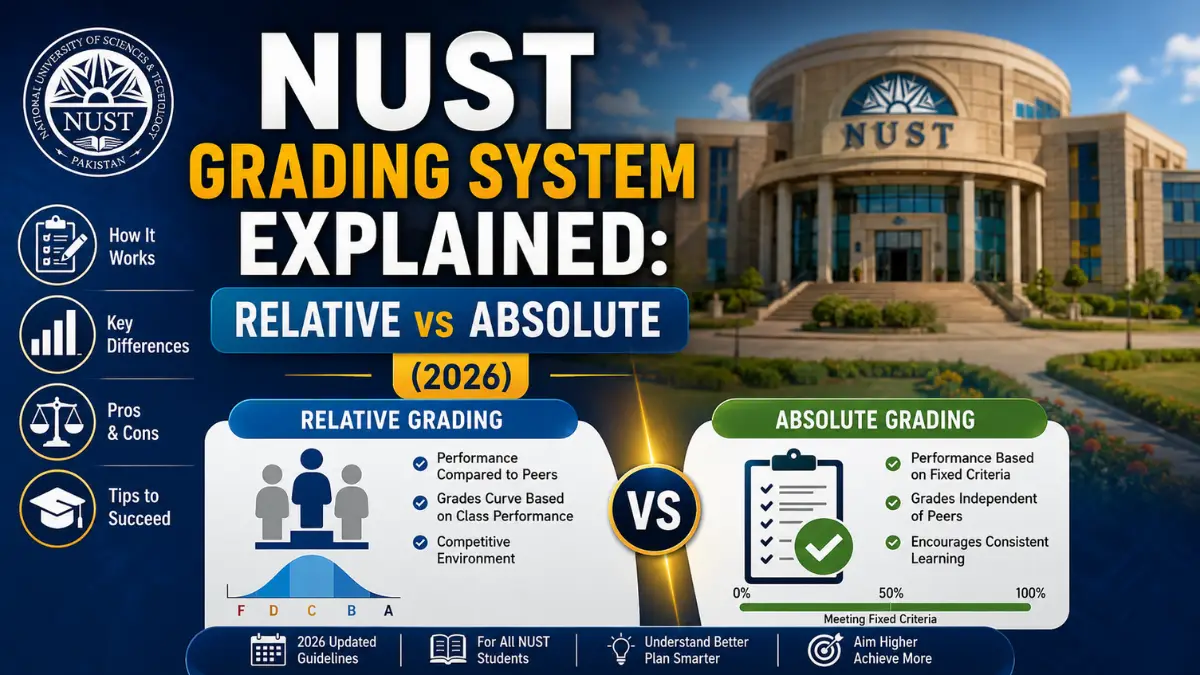
If you’ve just been admitted to the National University of Sciences and Technology, or you’re already a student staring at a transcript that doesn’t quite match what you scored on your exam, there’s a good reason for the confusion. NUST doesn’t grade the way most Pakistani universities do. It uses a relative grading system, and understanding how it works can change how you study, how you compete with classmates, and how you read your own CGPA.
This guide breaks down exactly how NUST’s grading system works, how it differs from the absolute grading system used at most other HEC-affiliated universities, and how to use an NUST CGPA calculator correctly once you understand the logic behind the numbers.
What Is the NUST Grading System?
NUST’s grading system sits on the standard 4.0 grade point scale, but with a structure that’s noticeably different from what most Pakistani students expect. Two things make it distinctive:
- It’s relative, not absolute; for most courses, your letter grade depends on how your class performed, not on a fixed percentage cutoff.
- It uses only 8 grade levels, A, B+, B, C+, C, D+, D, and F, with no A-, B-, or C- grades.
That second point trips a lot of students up. Universities like COMSATS, FAST, and IIUI use an 11-grade HEC-aligned scale with 0.33 increments between grades (4.00, 3.67, 3.33, 3.00…). NUST jumps in 0.50 increments instead (4.00, 3.50, 3.00, 2.50…). Fewer grade levels mean each individual grade carries more weight in your GPA; the gap between an A and a B+ at NUST is bigger than the gap between an A and an A- almost anywhere else.
The Official NUST Grading Scale
| Letter Grade | Grade Points | Notes |
| A | 4.00 | Highest grade |
| B+ | 3.50 | |
| B | 3.00 | |
| C+ | 2.50 | |
| C | 2.00 | Minimum passing grade for MS/PhD |
| D+ | 1.50 | Undergraduate only |
| D | 1.00 | Undergraduate only; minimum to earn course credit |
| F | 0.00 | Fail; course must be repeated |
Graduate students (MS/PhD) don’t have access to D+ or D; the minimum passing grade at that level is a C.
Relative Grading Deep-Dive: How It Actually Works
This is the part most students want explained properly, so let’s slow down.
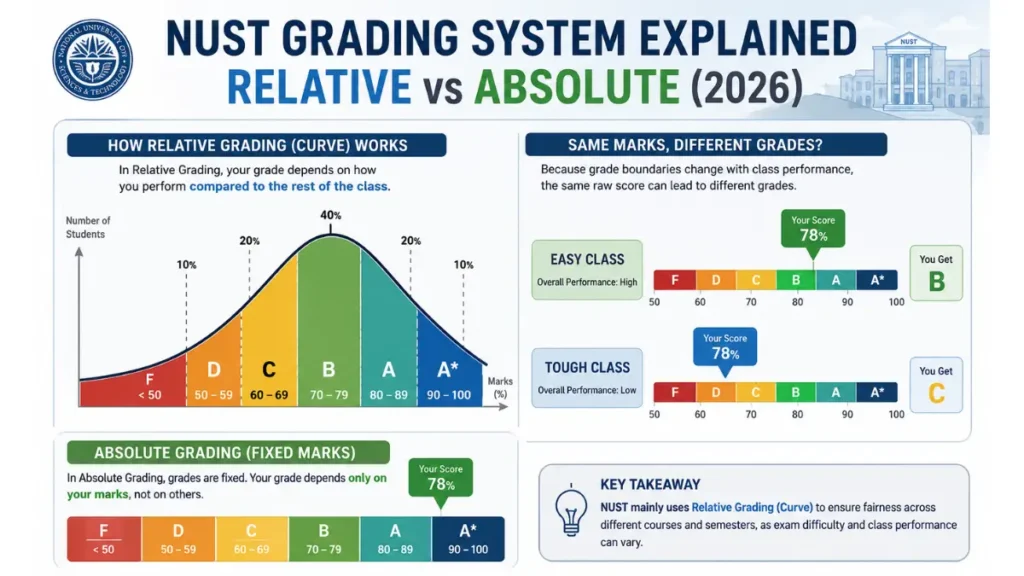
In a relative grading system, your grade point value stays fixed, but the letter grade you receive depends on where your raw marks fall relative to the rest of your class or section. There’s no universal rule that says “78% is a B+.” Instead, the instructor looks at the overall distribution of marks in that specific section and sets grade boundaries around it.
Here’s the practical effect: scoring 78% in an easier section might land you a B+, while the identical 78% in a tougher section, where the class average was lower, could actually be an A or A-equivalent. The reverse is also true. If your whole class does unusually well, the bar for an A moves up, and a score that would normally be excellent might only get you a B.
Why NUST Chose Relative Grading
NUST has used relative grading since it was established, and the reasoning behind it comes down to a few recurring points raised by university officials over the years:
- Exam difficulty varies between instructors and semesters. Relative grading protects students when a paper turns out to be unusually hard, since the curve adjusts for it.
- International recognition. Bodies like the Pakistan Engineering Council, and international accreditation standards more broadly, are generally more familiar with statistically curved grading in technical degrees.
- Consistency across sections. With NUST class sizes typically capped around 50 students and grouped partly by academic performance, relative grading is meant to keep grade distributions comparable across parallel sections of the same course.
The Trade-Off Students Should Know About
Relative grading has a well-documented downside: it can turn classmates into competitors. When your grade partly depends on how well your peers do, an unusually strong performance by a friend can, in theory, push your own grade down even if your own marks didn’t change. Some students describe this as raising stress levels and discouraging the kind of open group study that’s common at absolute-grading universities.
That’s a real trade-off, not a myth, it’s one of the most common complaints raised about the system by students and parents alike. It’s worth knowing about going in, so it doesn’t blindside you in your first semester.
Absolute Grading
To understand why NUST feels unusual, it helps to see the alternative side by side.
In an absolute grading system, grade boundaries are fixed in advance and never move, regardless of how the class performs. A typical absolute scale might look like: 85%+ is an A, 80–84% is an A-, 75–79% is a B+, and so on down to a failing cutoff. If everyone in the class scores above 85%, everyone gets an A. If everyone scores below the cutoff, everyone fails; the exam’s difficulty isn’t factored in at all.
Most Pakistani universities operating under standard HEC guidelines, including COMSATS, IIUI, and many others, default to this model, sometimes letting individual instructors choose between absolute and relative schemes on a per-course basis.
Relative vs Absolute at a Glance
| Factor | Relative Grading (NUST) | Absolute Grading (Most Others) |
| Grade boundary | Moves with class performance | Fixed percentage cutoffs |
| Predictability | Lower, depends on peers | Higher, you know the target in advance |
| Fairness on hard exams | Adjusts for difficulty | No adjustment |
| Competitive pressure | Higher | Lower |
| Group study incentive | Often discouraged | Usually encouraged |
| Used at | NUST (most programs), FAST, LUMS | COMSATS, IIUI, Punjab University, and others |
One notable exception inside NUST itself: the School of Art, Design & Architecture (SADA) applies absolute grading with fixed percentage bands for some of its course types, so not every NUST student experiences the curve the same way.
How to Calculate Your GPA and CGPA at NUST
Regardless of whether a course was graded on a curve, once the letter grade is assigned, the grade point value is fixed, and from there, GPA and CGPA calculations follow a standard formula.
Semester GPA formula:
SGPA = Σ (Grade Points × Credit Hours) ÷ Σ (Credit Hours)
Step-by-step example:
| Course | Credit Hours | Grade | Grade Points | Quality Points |
| Calculus I | 3 | A | 4.00 | 12.00 |
| Programming Fundamentals | 4 | B+ | 3.50 | 14.00 |
| Physics | 4 | B | 3.00 | 12.00 |
| English Composition | 3 | A | 4.00 | 12.00 |
| Islamic Studies | 2 | C+ | 2.50 | 5.00 |
Total quality points = 55.00. Total credit hours = 16. SGPA = 55.00 ÷ 16 = 3.44.
CGPA formula works the same way but sums quality points and credit hours across every semester completed so far:
CGPA = Σ (Credit Hours × Grade Points, all semesters) ÷ Σ (Total Credit Hours, all semesters)
Using a dedicated NUST CGPA calculator removes the manual arithmetic, especially once you’re combining multiple semesters with different credit loads. Just make sure the tool you use reflects NUST’s specific 0.50-increment scale rather than the generic 11-grade HEC scale; plugging NUST grades into a calculator built for a different university will give you the wrong number.
CGPA to Percentage: A Common Point of Confusion
NUST uses its own conversion formula, which differs from the generic HEC one:
Percentage = (CGPA × 25) − 12.5
So a CGPA of 3.00 converts to (3.00 × 25) − 12.5 = 62.5% under NUST’s formula, notably lower than the 75% you’d get from the standard CGPA ÷ 4.0 × 100 formula used elsewhere. This distinction matters when you’re applying for jobs or further studies abroad and need to state your percentage accurately.
Academic Standing and What Your CGPA Means
| CGPA (approx.) | Standing |
| 3.50+ | Dean’s List / merit scholarship range |
| 3.00 | Good standing |
| 2.50 | Minimum for BBA/BS Social Sciences graduation |
| 2.00 | Minimum for Engineering/IT graduation |
| Below 2.00 | Academic probation risk |
Falling below the minimum threshold triggers NUST’s tiered deficiency system, warning, probation, suspension, and ultimately withdrawal for repeated or serious cases. Because relative grading means your standing is partly shaped by class performance, it’s worth checking in with your academic advisor early if you’re near a threshold rather than assuming a “normal” semester will fix it.
Conclusion
NUST’s relative grading system is the single biggest thing that separates its academic experience from most other Pakistani universities. Your grade point values stay fixed on a familiar 4.0 scale, but where your raw marks land on that scale depends on the class you’re in, not a universal percentage cutoff. That trade-off can protect you from an unusually hard exam, but it also raises the competitive stakes among classmates.
If you’re heading into your first semester at NUST, the most useful thing you can do right now is stop thinking in terms of “I need 85% for an A” and start thinking in terms of “I need to perform above my class average.” Track your standing every semester with an accurate CGPA calculator, and talk to your advisor early if a semester doesn’t go the way you expected, not after your CGPA has already slipped.