
What Happens If Your GPA Falls Below 2.0?
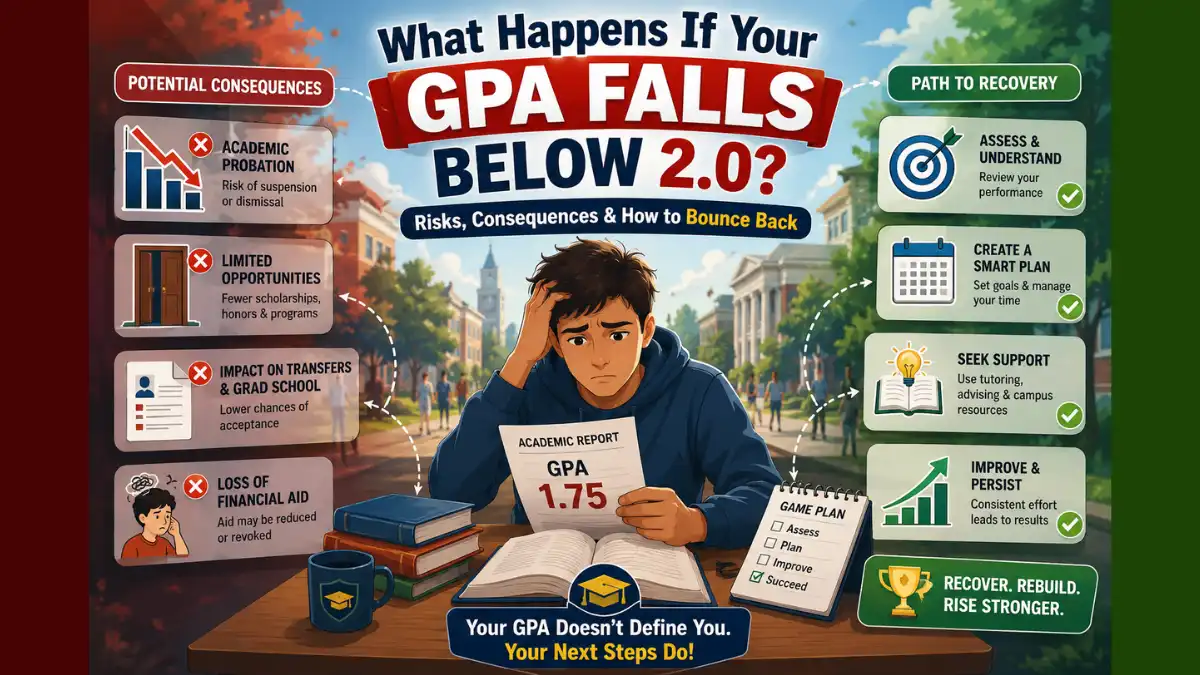
Your Grade Point Average (GPA) is more than just a number; it is a reflection of your academic commitment, and in many ways, a key that unlocks future opportunities. For millions of college and university students across the United States, the moment their GPA dips below 2.0 marks the beginning of one of the most stressful academic experiences possible: academic probation.
Whether you are a freshman who struggled through a difficult first semester or a junior facing unexpected personal challenges, a GPA below 2.0 can feel like the end of the road. But it doesn’t have to be. This comprehensive guide explains exactly what academic probation means, what consequences you may face, and most importantly, how to recover your academic standing and get back on track.
1. What Is Academic Probation?
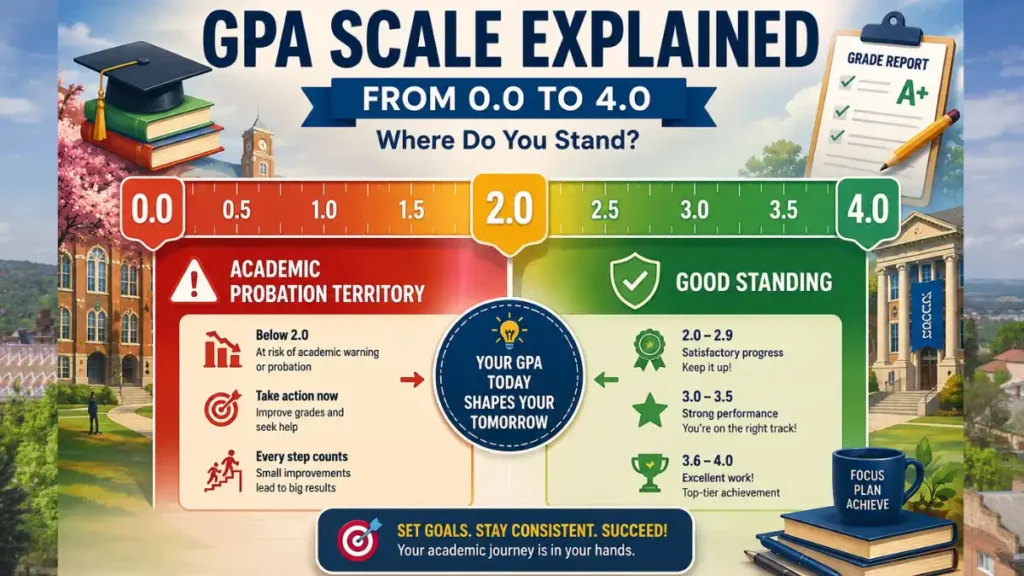
Academic probation is a formal warning status imposed by a college or university on students whose cumulative GPA falls below the institution’s minimum threshold, most commonly a 2.0 on a 4.0 scale. It signals that a student’s academic performance is unsatisfactory and that immediate improvement is required to remain enrolled.
Every institution has its own academic probation policy, but the core principle is the same: you are being given a defined period, typically one or two semesters, to bring your GPA back up to the required minimum.
1.1 Academic Probation vs. Academic Suspension vs. Academic Dismissal
Many students confuse these three statuses. Here is how they differ:
| Status | What It Means | Duration |
| Academic Probation | Formal warning; GPA below minimum threshold | Usually 1–2 semesters |
| Academic Suspension | Temporary removal from enrollment | 1 semester to 1 year |
| Academic Dismissal | Permanent removal from the institution | Permanent (appeals possible) |
1.2 The 2.0 GPA Threshold: Why It Matters
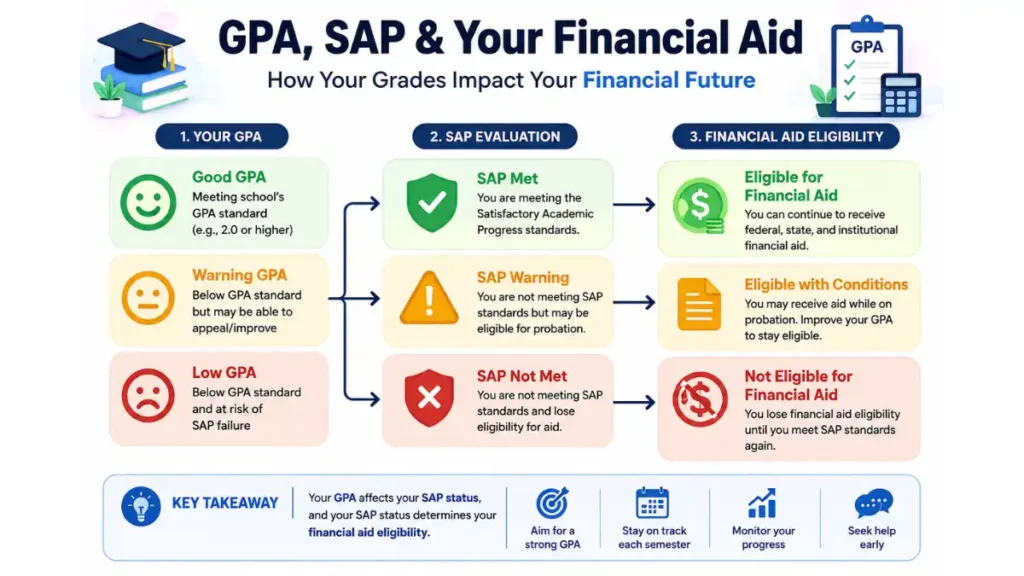
A 2.0 GPA corresponds to a ‘C’ average. Most accredited universities in the U.S. set this as the minimum cumulative GPA to maintain satisfactory academic progress (SAP), a standard also required by the federal government for students receiving financial aid. Calculate your GPA to know about your position.
2. Consequences of Having a GPA Below 2.0
The consequences of falling below a 2.0 GPA can be far-reaching and affect multiple areas of your academic and personal life. Below is a detailed breakdown:
2.1 Financial Aid Consequences
This is often the most immediate and painful consequence. Federal financial aid — including Pell Grants, Direct Loans, and work-study programs – is tied to Satisfactory Academic Progress (SAP). According to the U.S. Department of Education, students who do not meet SAP requirements may lose eligibility for all federal student aid.
Key financial impacts include:
- Loss of federal grants (Pell Grant, SEOG Grant)
- Suspension of federal student loan disbursements
- Loss of state-funded scholarships and grants
- Revocation of merit-based institutional scholarships
- Ineligibility for work-study programs
2.2 Scholarship Loss
Many private and institutional scholarships require a minimum GPA of 2.5 to 3.0. Even falling to a 2.1 or 2.2 can trigger scholarship suspension. Some scholarship providers offer a one-semester probationary period, while others revoke funding immediately upon receiving a failing term report.
Always read the fine print of your scholarship terms; some require a GPA review every semester, others annually.
2.3 Impact on Academic Programs and Majors
Certain programs have additional GPA requirements beyond the university’s baseline:
- Engineering programs often require a 2.5 minimum in major courses
- Nursing and health sciences frequently require a 3.0 or higher
- In many states, education programs require a 2.75 GPA for teaching certification
- Many business schools require a 2.5+ for continued enrollment in the major
If your GPA drops below department minimums, you may be administratively removed from your declared major and moved to an undecided or general studies track.
2.4 Housing and Campus Life
Some universities restrict on-campus housing for students on academic probation. Priority registration, allowing you to sign up for classes before others, may also be revoked, making it harder to get the courses you need to recover your GPA.
Extracurricular restrictions may include:
- Ineligibility to participate in varsity or club sports
- Suspension from student government or leadership roles
- Restriction from study abroad programs
- Exclusion from honor societies or academic clubs
2.5 Long-Term Career Implications
A poor academic record can affect your post-graduation opportunities in the following ways:
- Many employers, especially in finance, consulting, and government, require a minimum GPA of 3.0 on resumes
- Graduate school admissions typically require a minimum 3.0 cumulative GPA
- Professional schools (law, medicine, pharmacy) may reject applicants with an academic probation history
- Security clearances for government jobs can be affected by academic performance records
3. Common Reasons Students Fall Below a 2.0 GPA
Understanding why GPAs drop is the first step toward prevention and recovery. The most common contributing factors include:
| Category | Specific Factors |
| Personal Challenges | Mental health struggles, family emergencies, relationship issues, grief |
| Academic Difficulty | Overwhelming course load, poor study habits, wrong major fit |
| Financial Stress | Working too many hours, housing instability, food insecurity |
| Social Transitions | First-generation student adjustment, social pressure, party culture |
| Health Issues | Chronic illness, disability, substance use, lack of sleep |
| Poor Planning | Skipping classes, missing deadlines, procrastination |
Research consistently shows that first-generation college students and students from lower-income backgrounds face disproportionately higher risks of academic probation due to compounding stressors. [Verify citation]
4. The Academic Probation Process
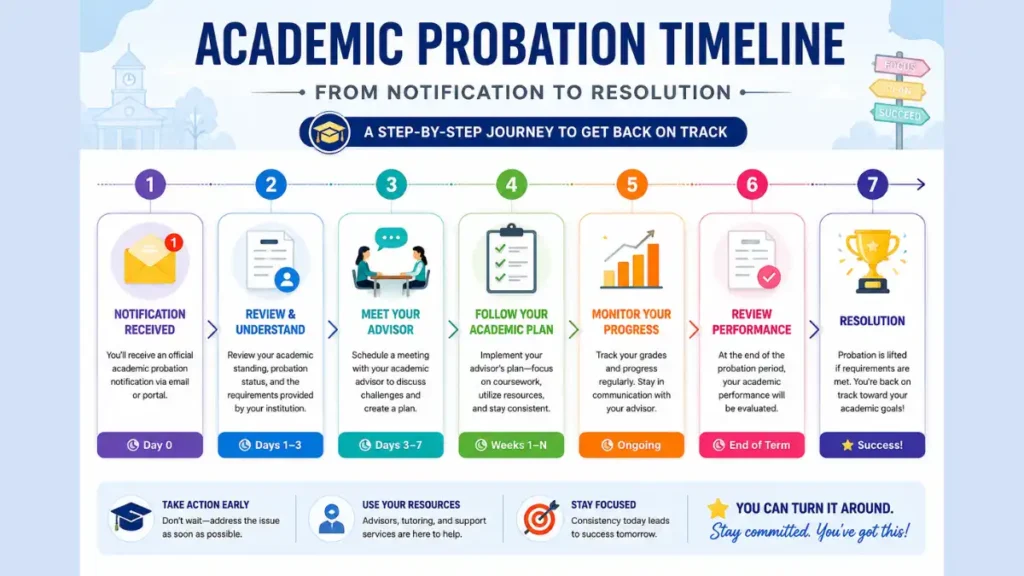
If your GPA drops below 2.0, here is what typically happens step by step:
- Official notification from the Registrar or the Dean of Students’ office, usually sent by email and letter
- A mandatory academic probation meeting with your academic advisor
- Creation of an Academic Improvement Plan (AIP) outlining required actions
- Possible enrollment restrictions (limited credit hours, required courses)
- A probationary semester with regular check-ins
- End-of-semester review: return to good standing, continued probation, or suspension
4.1 Academic Improvement Plans (AIPs)
An AIP is a formal document, co-created with your academic advisor, that outlines specific, measurable goals for academic recovery. It typically includes:
- Target GPA for the probationary semester
- Required study hours per week
- Mandatory tutoring or academic support sessions
- Course selection guidance (easier courses to raise GPA quickly)
- Mental health or counseling referrals if needed
5. How to Recover from Academic Probation: A Step-by-Step Guide
Academic probation is not the end; thousands of students recover from it every year and go on to graduate, pursue advanced degrees, and build successful careers. Here is a proven recovery roadmap:
Step 1: Acknowledge the Situation Without Shame
The first step is acceptance. Many students fall into denial or shame spirals that prevent them from seeking help. A GPA below 2.0 is a warning signal, not a life sentence. Reach out to your academic advisor immediately — the sooner you act, the more options you have.
Step 2: Identify the Root Cause
Was it the wrong major? Mental health challenges? Too many work hours? Pinpointing the root cause allows you to address the real problem, not just the symptom. Most universities offer free counseling and advising services specifically for students on academic probation.
Step 3: Strategically Select Your Courses
During your probationary semester, course selection is critical. Consider the following:
- Retake courses where you received D or F grade. Many schools replace the grade with GPA calculations
- Choose courses in your strongest subject areas
- Reduce your credit load to 12–14 hours rather than overloading
- Avoid back-to-back difficult courses in the same semester
- Take at least one pass/fail course if your university allows it
Step 4: Leverage Academic Support Resources
Most universities offer extensive free support that many students never use:
| Resource | What It Offers | How to Access |
| Writing Center | Essay and paper help | Walk-in or appointment |
| Math/Science Tutoring | 1-on-1 or group tutoring | Academic support center |
| Supplemental Instruction (SI) | Peer-led study sessions for hard courses | Dean of Students’ Office |
| Academic Coaching | Study strategies, time management | Dean of Students office |
| Counseling Services | Mental health support | Student health center |
| Financial Aid Appeals | Reinstate aid during recovery | Financial aid office |
Step 5: Master Time Management and Study Skills
Poor time management is one of the top contributors to academic failure. Use these proven strategies:
- Use a weekly planner and block dedicated study time
- Apply the Pomodoro Technique: 25 minutes focused work, 5-minute break
- Attend every class; studies show that attendance directly correlates with GPA
- Form study groups for difficult subjects
- Review notes within 24 hours of each class to improve retention
- Use apps like Notion, Todoist, or Google Calendar for task management
Step 6: Communicate With Your Professors
Many students are surprised to learn that professors appreciate proactive communication. Visit office hours, explain your situation honestly, and ask for guidance. Some professors offer extra credit opportunities, grade replacement, or late assignment policies that are not advertised on the syllabus.
Step 7: Consider a GPA Forgiveness or Grade Replacement Policy
Many institutions offer one or more of the following GPA recovery options:
- Academic Renewal / Fresh Start: Allows students returning after a gap to wipe previous grades from GPA calculations
- Grade Forgiveness: Replace a failed course grade when retaken (policies vary, some replace the grade, others average both)
- Course Withdrawal Deadlines: Drop a course before it negatively impacts your GPA (within the withdrawal window)
Step 8: Appeal Financial Aid Suspension
If your financial aid has been suspended due to SAP failure, you have the right to file a financial aid appeal. The appeal process typically requires:
- A written personal statement explaining why your GPA fell
- Documentation of any extenuating circumstances (medical records, death certificates, etc.)
- An Academic Plan approved by your advisor
- Evidence of changed circumstances or commitment to improvement
Many students successfully reinstate financial aid through the appeals process. Do not assume it is automatic — you must file the appeal by your institution’s stated deadline.
6. How Long Does It Take to Recover?
Recovery time depends on how far below 2.0 your GPA is and how many credits you have completed. Here is a general estimate:
| Current GPA | Credits Completed | Estimated Recovery Time |
| 1.8 – 1.9 | Less than 30 | 1 semester (with all A/B grades) |
| 1.5 – 1.7 | 30–60 credits | 2–3 semesters of strong performance |
| Below 1.5 | 60+ credits | 3–4+ semesters; consider academic renewal |
| Below 1.0 | Any | Consider fresh start or transfer options |
Use your institution’s GPA calculator tool (available on most registrar websites) to simulate how different grade scenarios will impact your cumulative GPA.
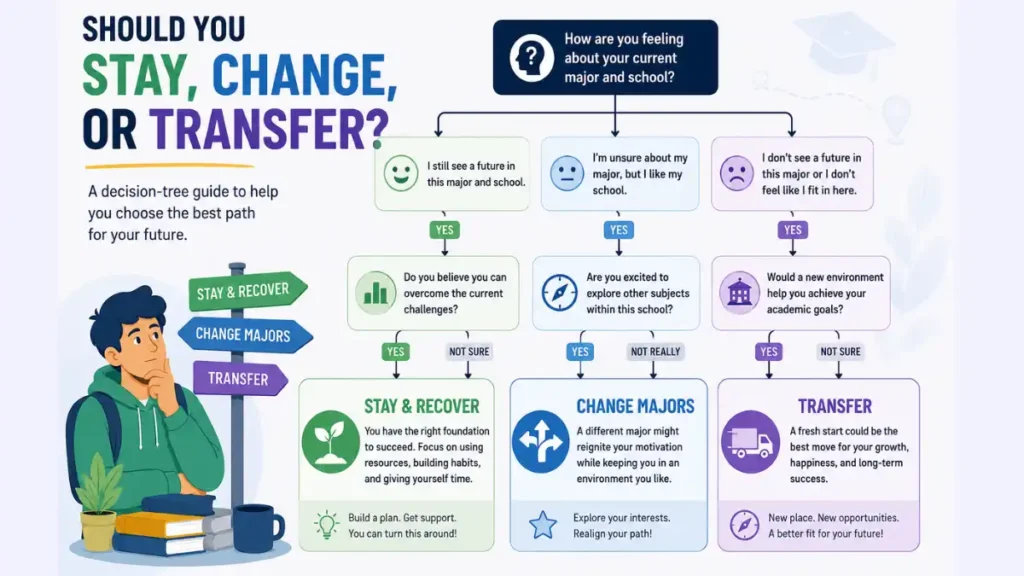
7. When to Consider Transferring or Changing Your Major
Sometimes, academic probation is a signal that the current institution or major is not the right fit. Consider these options:
- Community College Transfer: Some students transfer to a community college, rebuild their GPA, and then transfer back to a 4-year university
- Major Change: A mismatch between your strengths and your major is a common cause of academic struggles. Switching to a more compatible field often leads to dramatic GPA improvement
- Gap Year: Taking a planned semester or year off to address health, financial, or personal issues can be a strategic — not a failure — decision
- Academic Fresh Start Programs: Many universities offer these for returning students after an absence of 2–5 years
8. Academic Probation and Mental Health
The psychological toll of academic probation is significant and often underestimated. Research indicates that students on academic probation experience elevated rates of anxiety, depression, and shame. ( NAMI – Mental Health Resources for College Students )
If you are struggling emotionally, please know:
- Your university’s counseling center offers free or low-cost mental health support
- Academic probation does not define your intelligence or worth
- Many high-achieving professionals experienced academic difficulties in college
- Seeking help is a sign of strength, not weakness
Conclusion
A GPA below 2.0 and the resulting academic probation status is a serious situation, but it is one that many students have faced, overcome, and grown from. The consequences can be significant: lost financial aid, scholarship suspension, program removal, and long-term career impacts. However, with the right strategy, support, and mindset, recovery is not only possible but highly achievable.
The most important step you can take right now is to act. Do not wait for the next semester to begin, do not ignore emails from your advisor, and do not let shame keep you from seeking help. Visit your academic advisor, understand your institution’s specific policies, leverage every support resource available to you, and commit to a realistic recovery plan.
Your academic journey is not over. It is just entering a new chapter and this one can have a very different ending.