
What is a Good GPA in College? Complete Guide for 2026
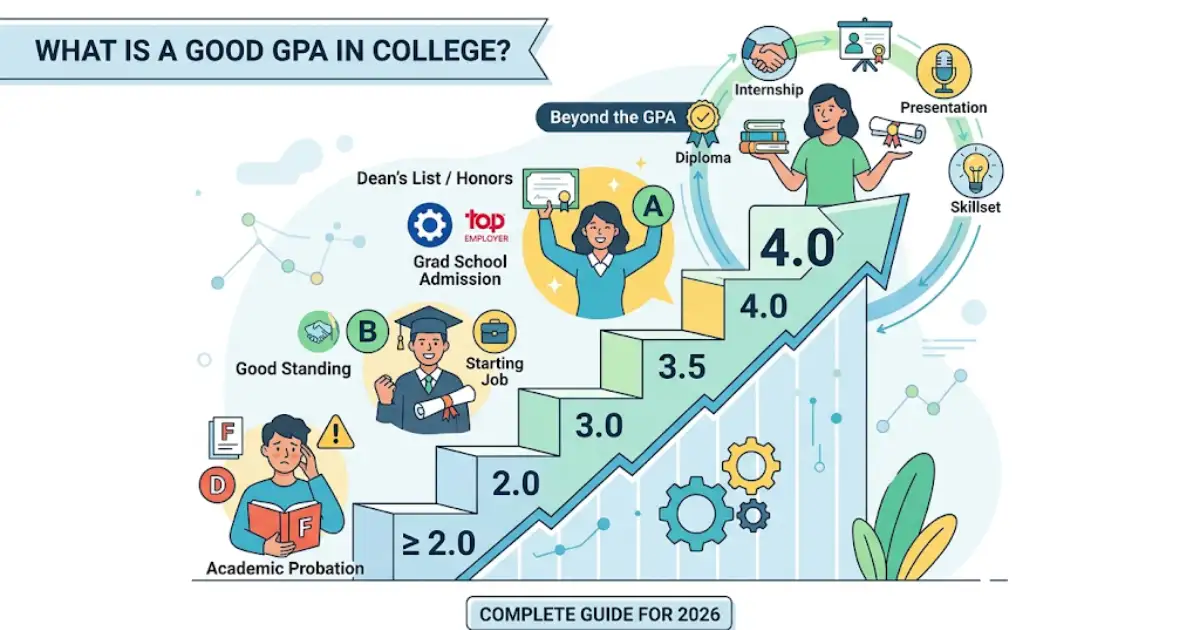
You just checked your final grades and your GPA ticker either gave you a rush of pride — or a quiet knot in your stomach. Either way, a number between 0.0 and 4.0 now shapes how you feel about the semester. But what does it actually mean? Is a 3.2 something to celebrate or worry about? Will a 3.6 get you into law school? Can a 2.8 land you a job at a Fortune 500 company?
This guide cuts through the noise. Below you’ll find clear benchmarks for employers, graduate programs, honors societies, and scholarships — plus a frank conversation about why the “good GPA” question rarely has a single right answer.
Understanding the College GPA Scale
Before judging whether your GPA is “good,” it helps to know exactly what the numbers represent. Most U.S. colleges use the standard 4.0 scale, though weighted and percentage-based alternatives exist.
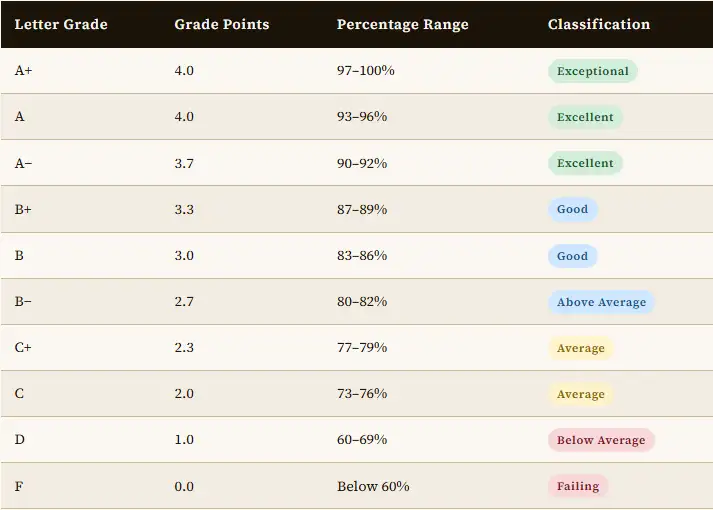
Your cumulative GPA is the weighted average of all grade points earned divided by total credit hours attempted. A single bad semester can drag down years of solid work, which is why understanding GPA trajectory matters as much as the number itself.
What Is the Average College GPA in 2026?
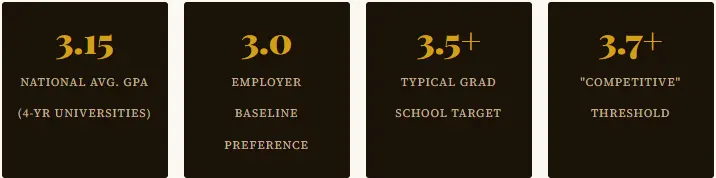
According to aggregated data from the National Center for Education Statistics (NCES), the average college GPA at four-year institutions hovers around 3.1–3.2, a figure that has drifted upward over the past two decades due to grade inflation. At elite research universities the reported mean can reach 3.4.
Key Insight
Grade inflation is real. A 3.0 in 1990 was harder to earn than a 3.0 today at many schools. Employers and admissions committees increasingly look at class rank, major rigor, and institutional context alongside raw GPA.
What Is Considered a Good GPA in College?
“Good” is context-dependent, but here are the thresholds that most gatekeepers actually use:
3.0 – 3.4: Solid and Competitive
A GPA in this range is respectable. It satisfies the minimum requirement for most graduate programs, meets the stated preference of a large majority of employers, and keeps federal financial aid intact. For many students balancing work, family obligations, and a demanding major, a 3.2 represents genuine academic achievement.
3.5 – 3.7: Above Average and Door-Opening
Once you cross 3.5, options expand meaningfully. Most merit scholarships activate here, selective graduate programs take your application seriously, and competitive employers in finance, consulting, and law stop filtering you out in early resume screens. This range earns you Latin honors at many schools (cum laude at roughly 3.5–3.6).
3.7 – 4.0: Excellent; The Top Tier
A 3.7+ signals elite academic performance. You’ll qualify for magna cum laude (typically 3.7–3.89) and summa cum laude (3.9+) designations, be competitive for prestigious fellowships like Fulbright and Rhodes scholarships, and have a strong application for MD, JD, and PhD programs. Phi Beta Kappa — the nation’s oldest academic honor society, typically requires a minimum 3.7–3.9.
"A 3.7 GPA doesn't just open doors, it often means the doors come to you."
Good GPA Benchmarks by Goal
For Graduate School
| Program Type | Minimum Typical GPA | Competitive GPA |
|---|---|---|
| Master’s (General) | 3.0 | 3.5+ |
| MBA (Top 25) | 3.2 | 3.6+ |
| Law School (T14) | 3.5 | 3.8+ |
| Medical School | 3.5 | 3.7+ |
| PhD Programs | 3.3 | 3.7+ |
| Dental School | 3.4 | 3.6+ |
Important Note
These figures are general benchmarks. Individual programs vary widely. A 3.4 GPA paired with exceptional research, work experience, or a compelling personal statement can outperform a 3.8 with nothing else to offer.
For Employment
Most corporate employers — especially in investment banking, consulting, and Big Tech — use 3.0 as a soft cutoff for campus recruiting screens. Some elite firms set theirs at 3.5. However, GPA matters much less post-graduation: after two years of work experience, recruiters prioritize portfolio, skills, and references over transcripts.
- Finance & Consulting: 3.5+ strongly preferred; some firms screen below 3.3
- Engineering & Tech: 3.0+ baseline; technical skills often outweigh GPA
- Healthcare: Varies widely; clinical experience often weighted equally
- Creative industries: Portfolio dominates; GPA rarely decisive
- Government & Nonprofit: 3.0+ generally sufficient
For Scholarships & Honors
| Honor / Scholarship | Typical GPA Requirement |
|---|---|
| Dean’s List | 3.5–3.7 (varies by school) |
| Cum Laude | 3.5–3.6 |
| Magna Cum Laude | 3.7–3.89 |
| Summa Cum Laude | 3.9–4.0 |
| Phi Beta Kappa | Top 10% of class (~3.7+) |
| National Merit Scholarship | 3.8+ |
| Fulbright Fellowship | 3.7+ recommended |
Does Your Major Affect What Counts as a Good GPA?
Absolutely. Grade distributions vary dramatically by discipline. A 3.2 in Chemical Engineering is widely considered excellent; a 3.2 in Communications may be seen as merely average at some institutions. Admissions committees and sophisticated employers understand this — many now evaluate GPA relative to major.
| Major Category | Average GPA (approx.) | Difficulty Context |
|---|---|---|
| STEM (Engineering, Chemistry) | 3.0–3.2 | Notoriously competitive grading |
| Pre-Med / Biology | 3.2–3.4 | High stakes, rigorous curves |
| Business | 3.2–3.4 | Moderate; varies by specialization |
| Humanities / Social Sciences | 3.3–3.5 | Higher average grades |
| Education | 3.4–3.6 | Historically higher averages |
| Fine Arts | 3.4–3.6 | Subjective grading, often higher |
How to Raise Your GPA: Practical Strategies for 2026
GPA recovery is not only possible — it’s common. Here’s what actually moves the needle:
1. Do the Math First
Use a GPA calculator to model realistic scenarios. Understand how many credits of A-level work you need to move from, say, 2.9 to 3.2 given your remaining semesters.
2. Front-Load Your Recovery
The earlier you act, the more leverage each semester has. A 3.8 semester junior year can meaningfully offset a rough freshman year. Waiting until senior year leaves too few credits to matter.
3. Strategic Course Selection
- Take courses where you can realistically excel, not just the ones that look impressive.
- Mix high-GPA-potential electives with required major courses.
- Consider retaking courses where you received a D or C if your school replaces grades.
- Talk to advisors about grade forgiveness or academic renewal policies.
4. Use Your Campus’s Academic Resources
- Office hours: Attending weekly office hours can improve performance by a full letter grade in many courses.
- Writing centers: Paper grades benefit enormously from professional feedback before submission.
- Tutoring centers: Particularly effective in STEM-heavy courses with cumulative content.
- Study groups: Peer-based teaching reinforces retention better than solo review.
5. Address Non-Academic Barriers
Poor grades are often symptomatic of underlying issues, such as financial stress, mental health, and undiagnosed learning differences. Many colleges in 2026 offer robust counseling, financial aid, emergency funds, and disability accommodations. Use them.
Quick Win
Talk to your professors before final exams, not after. Many are willing to offer extra credit, alternative assignments, or grade appeals for engaged students who communicate early.
Common GPA Myths Debunked
Myth #1: “GPA doesn’t matter after graduation.”
Partially true. GPA fades in relevance after several years of work experience. But for the first two to five years post-graduation — when you’re applying to grad school, early career jobs, or competitive fellowships — it absolutely matters.
Myth #2: “A 4.0 means you’re smarter than everyone.”
False. A 4.0 often reflects a mix of talent, strategic course selection, excellent time management, and an institutional environment conducive to high grades. It is a signal, not a certificate of intelligence.
Myth #3: “Employers always have a GPA cutoff.”
Largely false. Studies show fewer than 40% of employers use a formal GPA cutoff. Most evaluate candidates holistically. Strong internships, projects, and soft skills regularly trump marginal GPA differences.
Myth #4: “Once your GPA is low, it can’t recover.”
False. A student with a 2.5 after two years who earns a 3.8 cumulative GPA in years three and four will graduate near 3.15 — a meaningful shift. Upward GPA trends are viewed positively by many graduate admissions offices.
How Institution Type Affects GPA Context
A 3.5 at MIT carries a different weight than a 3.5 at an open-enrollment community college — and most professionals in hiring or admissions understand this. That said, it is not a reason to aim lower. Here’s a quick breakdown:
- Ivy League / Elite R1 Universities: Grade deflation is common; 3.5 here is exceptional.
- State Flagship Universities: 3.5 is strong; 3.7+ is highly competitive.
- Liberal Arts Colleges: Often have higher average GPAs; 3.8+ for top honors.
- Community Colleges: Transfer GPA is evaluated with context; 3.5+ for four-year transfers.
- Online Universities: Recognized by accreditors; GPA is scrutinized more by some employers.
The Bottom Line
There is no single “good GPA”; there is only a GPA that is good for your goal, your major, and your institution. The 3.0 floor is a practical baseline. The 3.5 threshold opens most doors. A 3.7 or above puts you in elite academic territory. But none of these numbers tells the full story of who you are as a student, thinker, or future professional.
What matters more than the number: the trajectory (is it trending up?), the context (what was the degree of difficulty?), and what you did alongside it: internships, research, leadership, and real-world impact.
Chase the best GPA you genuinely can, invest in experiences that round out your academic record, and don’t let a number define your potential.