
How to Calculate Your College GPA Step by Step
Your GPA is more than a number. It determines whether you qualify for the Dean’s List, keep your scholarship, maintain academic good standing, land that competitive internship, or gain admission to graduate school. Yet millions of college students go through an entire semester without truly understanding how it is calculated, and that ignorance can be costly.
The good news? Calculating your college GPA is not complicated once you understand the formula. Whether you want to double-check your institution’s calculation, model your GPA before finals, or plan how to raise it next semester, this step-by-step guide has you covered.
In this article, you will learn exactly how the GPA formula works, see it applied with real examples, understand the difference between semester GPA and cumulative GPA, and discover tools to make the process effortless.
What Is a College GPA?
GPA stands for Grade Point Average. It is a standardized measure that converts your letter grades into a numerical score, typically on a scale of 0.0 to 4.0 in the United States. Your GPA gives professors, advisors, employers, and admissions committees a quick way to assess your overall academic performance.
There are two types of GPA you will encounter in college:
- Semester GPA (also called Term GPA): Reflects your performance in a single semester or term. It resets at the start of each new term.
- Cumulative GPA: Reflects your overall performance across all completed semesters. This is the number that appears on your official transcript and is used for scholarships, graduate school applications, and job applications.
Related Blog: What Is a Good GPA In College?
The GPA Formula Explained
The core GPA formula used by virtually all US colleges and universities is:
| The Standard GPA Formula: GPA = Total Quality Points ÷ Total Credit Hours Attempted |
Where:
- Quality Points = Grade Points (for each course) × Credit Hours (for that course)
- Grade Points = The numerical value assigned to your letter grade (A = 4.0, B = 3.0, etc.)
- Credit Hours = The weight assigned to each course (typically 1–4 credits per course)
This is a weighted average, not a simple average of your grades. Heavier courses (more credit hours) have a greater effect on your GPA than lighter ones. A single poor grade in a 4-credit course will hurt your GPA more than the same grade in a 1-credit elective.
Standard Grade Point Scale (4.0 System)
Before you can apply the formula, you need to know the grade point value for each letter grade. The following is the standard 4.0 scale used by most US colleges and universities:
| Letter Grade | Grade Points | Percentage Range | Performance Level |
| A+ | 4.0 | 97–100% | Outstanding |
| A | 4.0 | 93–96% | Excellent |
| A- | 3.7 | 90–92% | Excellent |
| B+ | 3.3 | 87–89% | Very Good |
| B | 3.0 | 83–86% | Good |
| B- | 2.7 | 80–82% | Good |
| C+ | 2.3 | 77–79% | Average |
| C | 2.0 | 73–76% | Average |
| C- | 1.7 | 70–72% | Below Average |
| D+ | 1.3 | 67–69% | Poor |
| D | 1.0 | 63–66% | Poor |
| D- | 0.7 | 60–62% | Poor |
| F | 0.0 | Below 60% | Fail |
Note: Some colleges do not award A+ as a distinct grade point above 4.0. Always check your institution’s specific grading policy, as scales can vary slightly.
Step-by-Step: How to Calculate Your GPA
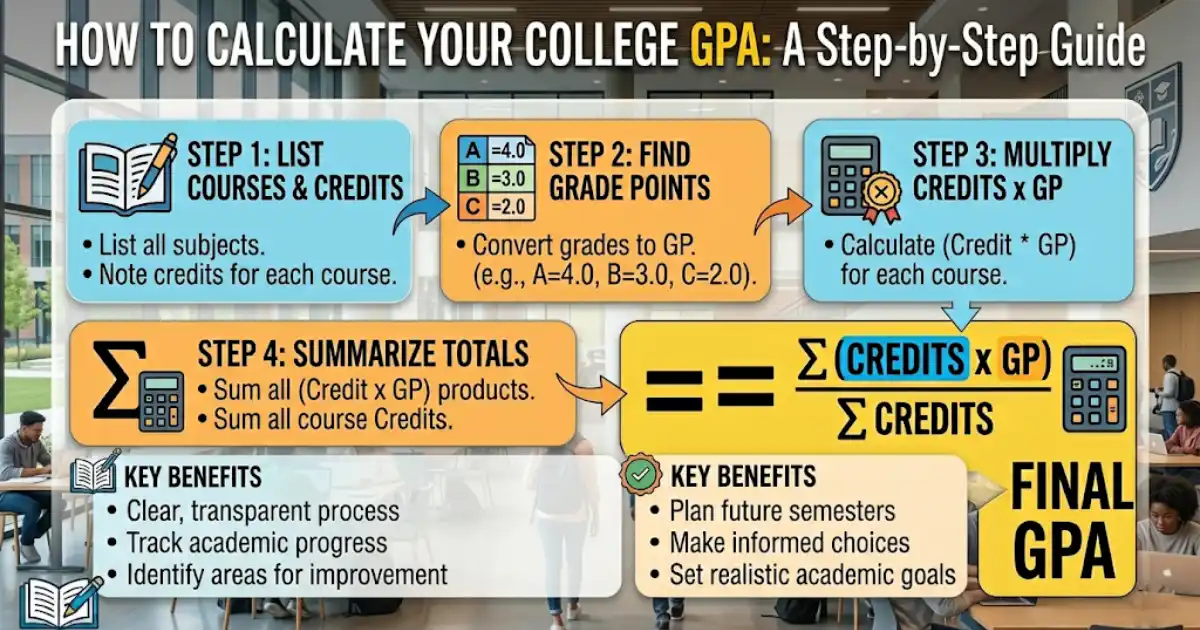
Follow these four steps to calculate your GPA for any semester:
Step 1 — List Your Courses, Grades, and Credit Hours
Gather your grade report or transcript. For each course, note the letter grade you received and the number of credit hours the course carried.
Step 2 — Convert Letter Grades to Grade Points
Using the grade point scale above, convert each letter grade to its numerical grade point value (e.g., B+ = 3.3, A = 4.0).
Step 3 — Calculate Quality Points for Each Course
Multiply the grade points for each course by its credit hours. This gives you the quality points for that course.
| Quality Points Formula: Quality Points = Grade Points × Credit Hours |
Step 4 — Divide Total Quality Points by Total Credit Hours
Add up all quality points across all courses. Divide the total by the total number of credit hours attempted. The result is your semester GPA.
Worked Example: Calculating a Semester GPA
Let’s walk through a realistic example. Suppose you completed the following courses in your spring semester:
| Course | Letter Grade | Grade Points | Credit Hours | Quality Points |
| English Composition | A- | 3.7 | 3 | 11.1 |
| Calculus I | B+ | 3.3 | 4 | 13.2 |
| Introduction to Psychology | A | 4.0 | 3 | 12.0 |
| Biology Lab | B | 3.0 | 2 | 6.0 |
| History of Art | C+ | 2.3 | 3 | 6.9 |
| TOTAL | — | — | 15 | 49.2 |
Applying the GPA formula:
| Calculation: GPA = 49.2 ÷ 15 = 3.28 |
Your semester GPA is 3.28, a solid B+ average. Notice how the 4-credit Calculus course has a larger impact on your GPA than the 2-credit Biology Lab. That is the weighted nature of the formula at work.
How to Calculate Your Cumulative GPA
Your cumulative GPA covers every semester you have completed. It is not simply an average of your semester GPAs — it is a weighted calculation across all credit hours and quality points from all terms.
| Cumulative GPA Formula: Cumulative GPA = Σ All Quality Points ÷ Σ All Credit Hours Attempted |
Cumulative GPA Example
Suppose your academic record looks like this:
| Semester | Quality Points | Credit Hours | Semester GPA |
| Freshman Fall | 48.0 | 15 | 3.20 |
| Freshman Spring | 49.2 | 15 | 3.28 |
| Sophomore Fall | 55.2 | 16 | 3.45 |
| Sophomore Spring | 51.0 | 15 | 3.40 |
| CUMULATIVE | 203.4 | 61 | 3.33 |
Cumulative GPA = 203.4 ÷ 61 = 3.33
Even though Sophomore Fall produced the highest semester GPA (3.45), the cumulative GPA is pulled toward the center because earlier semesters contributed more total credit hours. This illustrates why it is harder to significantly raise your cumulative GPA in later years, and why strong early performance matters so much.
Weighted vs. Unweighted GPA: What’s the Difference?
You may have heard these terms in a high school context, but they also appear in college discussions:
| Type | Scale | How It Works | When Used |
| Unweighted GPA | 0.0–4.0 | All courses treated equally regardless of difficulty | Standard college GPA system |
| Weighted GPA | 0.0–5.0+ | Honors/AP/advanced courses earn extra grade points | Primarily high school; rare in college |
At most US colleges and universities, the standard (unweighted) 4.0 system is used. Unless your institution explicitly states otherwise, assume you are working with an unweighted 4.0 scale.
Common GPA Calculation Mistakes to Avoid
- Using a simple average of grades instead of a weighted calculation by credit hours.
- Forgetting to include failed or repeated courses, an F is still 0 quality points and counts toward attempted hours.
- Assuming all courses carry the same credit hours when they do not.
- Confusing semester GPA with cumulative GPA when reporting to employers or scholarship committees.
- Not accounting for grade replacements, some colleges allow a repeat course to replace the original grade, but policies differ widely.
What GPA Do You Need? Common Benchmarks
Understanding what different GPA ranges mean for your goals can help you set realistic targets:
| GPA Range | Letter Equivalent | Common Implications |
| 3.7–4.0 | A / A- | Dean’s List, top graduate school eligibility, most scholarships |
| 3.5–3.69 | A- | Dean’s List at many schools, competitive grad school candidate |
| 3.0–3.49 | B / B+ | Good standing, many graduate programs, most employer requirements met |
| 2.5–2.99 | C+ / B- | Academic warning zones; some scholarships and programs inaccessible |
| 2.0–2.49 | C | Minimum standing for graduation at most colleges |
| Below 2.0 | D / F | Academic probation risk; financial aid may be affected |
Practical Tips to Improve Your GPA
- Prioritise high-credit courses: A strong grade in a 4-credit course lifts your GPA far more than the same grade in a 1-credit elective. Identify your heavy courses and study accordingly.
- Attend every class: Research consistently shows that class attendance is one of the strongest predictors of academic performance. Each absence compounds over a semester.
- Use office hours: Professors are required to hold them. Students who attend office hours regularly perform, on average, half a letter grade higher.
- Understand your transcript before finals: Run your GPA calculation mid-semester. Know exactly what grade you need in your final exam to hit your target GPA.
- Strategic course selection: If allowed, mix challenging courses with lighter ones to balance your workload and protect your GPA during difficult semesters.
- Talk to your academic advisor early: If you are at risk of academic probation, early intervention (petitions, medical withdrawals, grade forgiveness policies) is far more effective than waiting until after grades are posted.
Conclusion
Calculating your college GPA is a four-step process: list your courses and grades, convert letter grades to grade points, multiply by credit hours to get quality points, and divide the total quality points by total credit hours. That is it — one straightforward formula that powers an enormously important number.
Your GPA is not fixed. Every semester is a new opportunity to raise it, protect it, or plan around it. Armed with this knowledge, you can make smarter academic decisions: which courses to prioritize, when you need a strong finals performance, and what cumulative target to chase for your next goal.