
BMI Calculator: Check Your Body Mass Index
Understanding your body mass index is one of the quickest ways to assess your general health. Whether you want to calculate BMI for personal fitness tracking or medical reasons, our free BMI(Body Mass Index) calculator provides instant, accurate results alongside your personalized healthy weight range.
Unlike standard tools, our GPA Calculator College goes a step further by offering advanced body metrics and contextual results tailored specifically for you.
How to Calculate BMI of Body
If you are wondering exactly how to calculate BMI, the math is a straightforward formula based on your height and weight. Our tool does this automatically, but if you want to know the manual BMI calculation, here is the global standard formula:
Standard (US) Formula:
- BMI = (Weight in Pounds / (Height in Inches x Height in Inches)) x 703
Metric Formula:
- BMI = Weight in Kilograms / (Height in Meters x Height in Meters)
Many people search the web asking “calculate BMI how” or “how calculate the BMI” because doing the math on a standard calculator can lead to order-of-operation errors. Using our dedicated web tool ensures you get a 100% mathematically flawless result without the headache.
BMI Calculator for Women vs. Men: Is There a Difference?
One of the most common questions we see is whether a BMI calculator female differs from a BMI calculator men.
Here is the medical reality: the actual math used in a BMI calculator women and men use is exactly the same. The World Health Organization (WHO) scale does not change the numerical brackets based on gender. A score of 24 is considered “Normal Weight” regardless of your sex.
However, how you interpret that score changes. Women naturally require a higher percentage of essential body fat for healthy reproductive function compared to men. Conversely, a BMI calculator men use might classify a highly muscular male athlete as “overweight” because the basic formula cannot distinguish between heavy muscle mass and fat. This is why our tool includes a gender toggle—to provide you with the correct medical context for your specific result!
Understanding the WHO BMI Scale
Once you use our tool to find your number, it will automatically highlight where you stand on the official World Health Organization classification table:
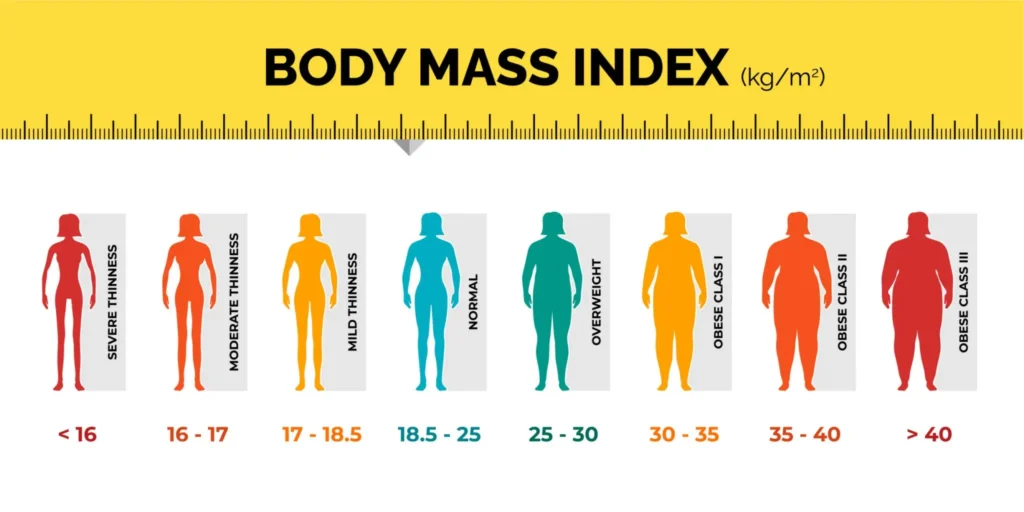
- Underweight: A score below 18.5. This may indicate a caloric deficit or an underlying health issue.
- Normal Weight: A score between 18.5 and 24.9. Falling into this range is generally associated with the lowest risk of weight-related illnesses.
- Overweight: A score between 25.0 and 29.9.
- Obese: A score of 30.0 or higher.
Advanced Metrics: Beyond the Basic BMI Calculation
To give you the most complete picture of your health, our tool includes two advanced metrics that most standard calculators skip:
- BMI Prime: This is a simple ratio of your actual BMI compared to the upper limit of the “Normal” weight category (25). A BMI Prime between 0.74 and 1.0 is considered ideal.
- Ponderal Index: Similar to BMI, but it cubes your height instead of squaring it. Many medical professionals prefer this metric for very tall or very short individuals, as it scales more accurately to extreme heights.