
What is SGPA and CGPA? Difference Explained for Indian Students
Consider this: you just received your semester marksheet, and two confusing acronyms stare back at you, SGPA and CGPA. You know they relate to your grades, but you’re not entirely sure what each one means, how it is calculated, or why it matters for your future. You are not alone. Millions of students across Indian universities face this exact confusion every single semester.
In India, the grading system has shifted dramatically over the past decade. Following the University Grants Commission (UGC) guidelines, most central and state universities, IITs, NITs, and autonomous colleges now use a 10-point grading scale. Within this system, two terms dominate every student’s academic life: SGPA and CGPA. Understanding the difference between them is not just academic trivia; it can determine your eligibility for scholarships, jobs, and postgraduate admissions.
This comprehensive guide explains what SGPA and CGPA are, how they differ, how they are calculated, and why both matter in the Indian academic context.
What is SGPA? (Semester Grade Point Average)
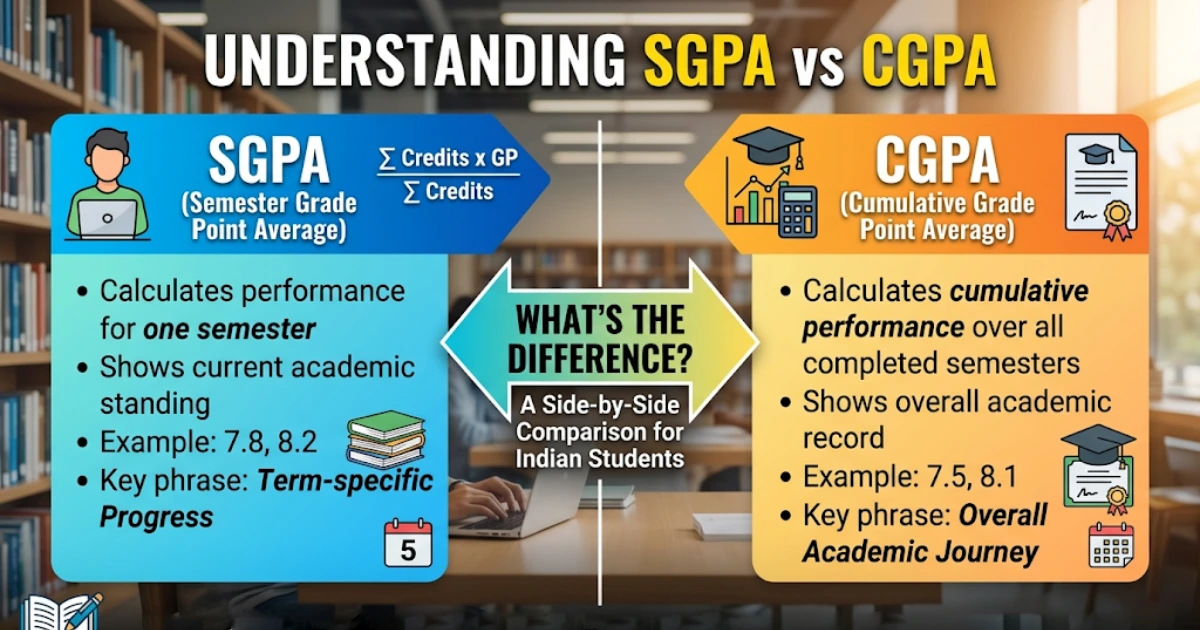
SGPA stands for Semester Grade Point Average. As the name suggests, it represents your academic performance during a single semester. Every semester you complete, you receive an SGPA score — a number that reflects how well you performed in the courses you studied during that specific term.
SGPA is a weighted average. This means it does not treat all subjects equally; instead, it gives more weight to subjects that carry more credit hours. A 4-credit course, for instance, has a greater influence on your SGPA than a 2-credit course.
SGPA Formula
| SGPA Calculation Formula: SGPA = Σ(Grade Point × Credit Hours) ÷ Σ(Credit Hours) |
Where:
- Grade Point is the numerical value assigned to the grade you received (e.g., O = 10, A+ = 9, A = 8, B+ = 7, etc.)
- Credit Hours are the weightage assigned to each subject by your university
SGPA Example Calculation
| Subject | Credits | Grade Point |
| Mathematics | 4 | 9 (A+) |
| Physics | 3 | 8 (A) |
| Chemistry | 3 | 7 (B+) |
| English | 2 | 10 (O) |
| Lab Work | 2 | 9 (A+) |
| Total / SGPA | 14 | 8.57 |
SGPA = (4×9 + 3×8 + 3×7 + 2×10 + 2×9) ÷ (4+3+3+2+2) = 120 ÷ 14 ≈ 8.57
What is CGPA? (Cumulative Grade Point Average)
CGPA stands for Cumulative Grade Point Average. Unlike SGPA, which measures only one semester, CGPA is a running total that reflects your academic performance across all completed semesters. It is the number most employers, universities, and scholarship committees look at when evaluating your academic record.
Think of SGPA as your monthly salary and CGPA as your annual average income. The monthly figure (SGPA) shows your current momentum, while the annual figure (CGPA) shows your broader financial health over time.
CGPA Formula
| CGPA Calculation Formula: CGPA = Σ(SGPA × Total Credits in Semester) ÷ Σ(Total Credits of All Semesters) |
Alternatively, some universities compute CGPA by treating all semesters together and applying the same weighted average formula used for SGPA but across the entire degree:
| Alternative CGPA Formula: CGPA = Σ(Grade Point × Credit Hours of ALL semesters) ÷ Σ(All Credit Hours) |
CGPA Example Calculation
Suppose a student’s SGPA scores across four semesters are:
| Semester | SGPA | Credits |
| Semester 1 | 8.57 | 14 |
| Semester 2 | 8.20 | 16 |
| Semester 3 | 9.10 | 15 |
| Semester 4 | 8.80 | 15 |
CGPA = (8.57×14 + 8.20×16 + 9.10×15 + 8.80×15) ÷ (14+16+15+15)
CGPA = (119.98 + 131.20 + 136.50 + 132.00) ÷ 60 = 519.68 ÷ 60 ≈ 8.66
SGPA vs CGPA: Key Differences at a Glance
The table below summarises the core differences between SGPA and CGPA that every Indian student should know:
| Feature | SGPA | CGPA |
| Full Form | Semester Grade Point Average | Cumulative Grade Point Average |
| Scope | Single semester only | All semesters combined |
| Calculation | Weighted avg of one semester | Weighted avg of all semesters |
| Reset each term? | Yes — starts fresh each semester | No — carries forward cumulatively |
| Used for | Semester performance, internal use | Graduation, jobs, higher studies |
| Best reflects | Recent academic performance | Overall academic journey |
| Scale (India) | Typically 10-point scale | Typically 10-point scale |
How Indian Universities Grade Students: The 10-Point Scale
The UGC (University Grants Commission) recommended a uniform 10-point grading scale for all higher education institutions in India. While individual universities may vary slightly, the general grade-point mapping is:
| Grade | Grade Point | Marks Range | Performance |
| O (Outstanding) | 10 | 90–100% | Exceptional |
| A+ (Excellent) | 9 | 80–89% | Excellent |
| A (Very Good) | 8 | 70–79% | Very Good |
| B+ (Good) | 7 | 60–69% | Good |
| B (Above Avg) | 6 | 55–59% | Above Average |
| C (Average) | 5 | 50–54% | Satisfactory |
| P (Pass) | 4 | 45–49% | Pass |
| F (Fail) | 0 | Below 45% | Fail |
Note: Grading scales may differ across universities. Always refer to your specific institution’s academic regulations for the exact grade point assignments.
How to Convert CGPA to Percentage in India
One of the most common questions Indian students ask is how to convert their CGPA into a percentage, because many job applications, bank loan forms, and foreign universities still require percentage-based scores.
General Formula (UGC Recommended)
| CGPA to Percentage Conversion: Percentage = CGPA × 9.5 |
Example: If your CGPA is 8.66, your equivalent percentage = 8.66 × 9.5 = 82.27%
However, different universities use different multipliers:
- Anna University: Percentage = (CGPA – 0.5) × 10
- Mumbai University: Uses its own internal conversion table
- VTU (Visvesvaraya Technological University): Percentage = (CGPA – 0.75) × 10
- IP University: Percentage = 7.1 × CGPA + 11
Why SGPA and CGPA Matter for Indian Students
1. Campus Placements and Job Applications
Most Indian companies, especially those that recruit through campus drives, specify a minimum CGPA cutoff. TCS, Infosys, Wipro, and other large IT employers typically require a CGPA of 6.0 or above. Core engineering companies and MNCs often set the bar at 7.0 or higher. Your SGPA in the most recent semester may also reflect your current capability and motivation.
2. Postgraduate Admissions (M.Tech, MBA, M.Sc)
Entrance exams like GATE, CAT, and CUET-PG accept students based on a combination of entrance scores and CGPA. IITs and NITs often require a minimum CGPA of 6.5 on a 10-point scale for M.Tech admissions. For MBA programs, a CGPA of 7.0+ is generally preferred.
3. Scholarships and Fellowships
Government scholarships such as the National Scholarship Portal (NSP) awards and CSIR-UGC fellowships typically require minimum CGPA thresholds. International scholarships, such as Commonwealth Scholarships and Fulbright, also look at your cumulative academic record.
4. Study Abroad Applications
Foreign universities convert Indian CGPA to a GPA equivalent on a 4.0 scale. Most graduate programs abroad expect the equivalent of at least a 3.0 GPA, which roughly translates to a CGPA of 7.5 or above on a 10-point Indian scale.
5. Government Job Eligibility
UPSC, SSC, and state public service commissions do not typically use CGPA as a qualifier, but academic performance can be relevant for direct recruitment in scientific and technical positions under central government departments.
Common Mistakes Students Make Regarding SGPA and CGPA
- Assuming SGPA and CGPA are the same thing, they are distinct metrics with different scopes.
- Ignoring credit weightage a single high-credit subject can significantly shift your SGPA.
- Thinking a strong SGPA in the final year will significantly raise a low CGPA, the cumulative nature means earlier semesters have a lasting impact.
- Not knowing your university’s specific grading scale can lead to errors in self-assessment and job applications.
- Confusing CGPA on a 10-point scale with GPA on a 4.0 scale when applying abroad without proper conversion.
Tips to Improve Your SGPA and CGPA
- Prioritise high-credit subjects: Focus extra study time on subjects with more credit hours since they impact your SGPA more.
- Do not write off any semester: Poor early performance is difficult to reverse because of the CGPA’s cumulative nature.
- Understand your grading scale thoroughly: Different universities have different grade point assignments.
- Attempt backlogs early: Uncleared backlogs count as fails (0 grade points) and can seriously damage your CGPA.
- Use online CGPA calculators: Tools that let you model different grade scenarios can help you set realistic targets.
Conclusion
SGPA and CGPA are two sides of the same coin in the Indian grading system. SGPA tells the story of a single chapter — one semester — while CGPA narrates the full book of your academic journey. Both numbers matter, though in different ways and at different points in your career.
As a student in India’s CBCS (Choice-Based Credit System) framework, understanding how these scores are calculated, what they mean, and how to use them strategically is essential. Whether you are aiming for a campus placement, a government job, an M.Tech seat, or a scholarship abroad, your CGPA will follow you,so it pays to understand it deeply from day one.
Remember: every semester is an opportunity to strengthen your cumulative average. And now that you understand the difference between SGPA and CGPA, you are better equipped to chart the academic path you want.