
Body Fat Calculator: Army Tape Test & Standard Navy Method
Body Fat Calculator: Army Tape Test & Standard Navy Method
Related Calculators: BMI Calculator & Calorie Calculator
About the Body Fat Calculator
Stepping on a standard bathroom scale only tells you your total body weight; it cannot distinguish between three pounds of dense muscle and three pounds of fat. Whether your goal is to optimize your metabolic health, build a leaner physique, or ensure you meet strict military physical readiness standards, understanding your exact body composition is the most critical step in your fitness journey.
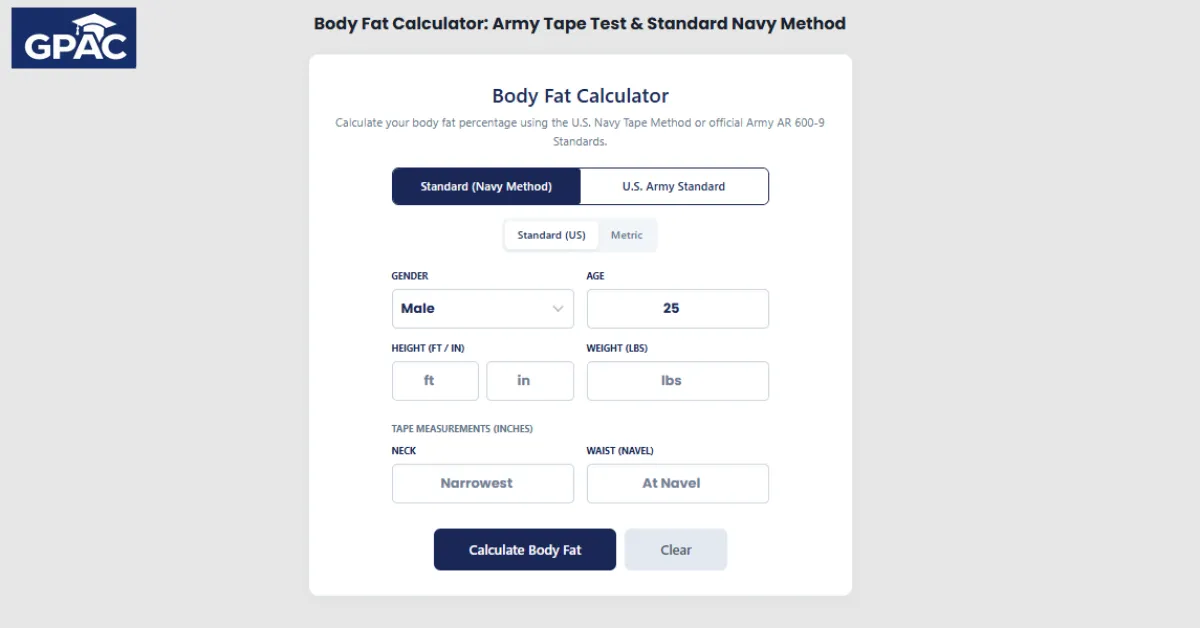
Our comprehensive, scientifically backed body fat calculator removes the guesswork from your health tracking. Recognizing that our users have vastly different goals, we engineered this tool with a seamless dual-mode interface. You can track your general fitness using the globally recognized U.S. Navy Tape Method, or instantly switch to the official Army body fat calculator to determine your precise compliance with strict AR 600-9 military regulations.
Why Body Composition Matters More Than BMI
While tools like the Body Mass Index (BMI) are useful for looking at broad population trends, they are fundamentally flawed for individual fitness tracking because they do not account for muscle mass. A highly trained athlete with a low body fat percentage might weigh enough to be classified as “overweight” or even “obese” on a standard BMI chart.
By using our body fat percentage calculator, you split your total weight into two highly revealing categories:
- Fat Mass: The total physical weight of the adipose tissue in your body. This includes both subcutaneous fat (the visible fat stored just beneath the skin) and visceral fat (the internal, metabolically active fat that surrounds your vital organs).
- Lean Body Mass (LBM): The combined weight of absolutely everything else in your body. Your lean mass includes your skeletal muscles, bone density, internal organs, blood, and total body water.
Increasing your lean mass while lowering your fat mass improves your metabolic rate, reduces the risk of cardiovascular disease, and enhances your overall physical performance.
How to Calculate Body Fat Percentage: The U.S. Navy Method
For decades, the standard for clinical body fat measurement required highly expensive equipment, such as Dual-Energy X-Ray Absorptiometry (DEXA) scans or hydrostatic (underwater) weighing.
However, in 1984, researchers Dr. Hodgdon and Dr. Beckett at the Naval Health Research Center developed a highly accurate mathematical alternative. If you are researching how to calculate body fat percentage at home, the U.S. Navy Method is widely considered the most accurate manual estimation available.
To use our tool to calculate fat percentage body metrics accurately, you must take careful circumference measurements using a non-stretch fiberglass measuring tape. Here is how to calculate body fat correctly:
- Height: Measure your height while standing completely straight without shoes.
- Neck Measurement: Look straight ahead and relax your shoulders. Place the measuring tape flat around your neck, just below the larynx (Adam’s apple). Do not pull the tape too tight.
- Waist Measurement (Men): Stand naturally. Measure horizontally around your abdomen exactly at the level of the navel (belly button). Do not suck in your stomach.
- Waist Measurement (Women): Measure horizontally at the absolute narrowest point of your abdomen, which is usually situated halfway between your lowest rib and your belly button.
- Hip Measurement (Women Only): Because female biology dictates a different natural fat distribution for reproductive health, women must also measure their hips. Place the tape around the absolute widest downward extension of the hips and buttocks.
The Mathematical Formulas (Navy Standard)
When you input these measurements into our tool, our algorithm instantly computes complex logarithmic equations to determine your body density and fat percentage. For those interested in the exact scientific calculations driving this tool, here are the official formulas used:
For Men:
For Women:
(Note: In the formulas above, all physical measurements must be computed in inches).
The Official U.S. Army Body Fat Calculator (AR 600-9)
Military personnel operate under incredibly strict physical readiness guidelines. If you are an active-duty soldier preparing for your physical, or a recruit hoping to enlist, an accurate army calculator for body fat is an absolute necessity.
In the United States Army, soldiers are routinely weighed. If a soldier exceeds the maximum screening weight for their height and age, they are immediately flagged for a “tape test.” By clicking the “U.S. Army Standard” tab on our tool, the algorithm abandons general fitness guidelines and strictly enforces the official AR 600-9 Army Body Composition Program regulations.
Whether you are looking for an APFT body fat calculator (Army Physical Fitness Test) or its modern ACFT equivalent, our tool acts as your personal evaluator. It cross-references your exact age, gender, and tape measurements against the Department of Defense tables to tell you instantly whether you Pass or Fail.
Maximum Allowable Body Fat Percentages (Army Standards)
To calculate body fat percentage army commanders will accept, you must fall at or below the following strict thresholds. Notice that the army allows slightly higher fat percentages as soldiers age to account for natural physiological changes over a long military career.
Male Army Standards:
- Age 17–20: Maximum 20% Body Fat
- Age 21–27: Maximum 22% Body Fat
- Age 28–39: Maximum 24% Body Fat
- Age 40 and older: Maximum 26% Body Fat
Female Army Standards:
- Age 17–20: Maximum 30% Body Fat
- Age 21–27: Maximum 32% Body Fat
- Age 28–39: Maximum 34% Body Fat
- Age 40 and older: Maximum 36% Body Fat
Failing to meet these standards during a tape test can result in a soldier being flagged, enrolled in a mandatory weight control program, barred from promotions, or eventually separated from military service. Utilizing our army pt body fat calculator regularly ensures you are never caught off guard during your official weigh-in.
Understanding the American Council on Exercise (ACE) Categories
If you are using the standard “Navy Method” mode on our calculator for civilian fitness tracking, your final percentage will be matched against the clinical health guidelines established by the American Council on Exercise (ACE).
Our GPAC tool automatically moves the visual gauge to show you exactly where you sit within these five critical health categories:
1. Essential Fat (Men: 2-5% | Women: 10-13%)
It is a common misconception that humans should strive for zero body fat. In reality, having 0% body fat would be fatal. Essential fat is the absolute minimum amount of fat required for basic survival. This fat is stored in your bone marrow, brain, spinal cord, and internal organs. It regulates core body temperature, absorbs fat-soluble vitamins (A, D, E, and K), and sustains crucial hormone production. Dropping below these essential levels can cause severe cardiovascular issues, osteoporosis, and reproductive system failure.
2. Athletes (Men: 6-13% | Women: 14-20%)
This is the range typically seen in highly competitive, professional athletes, such as sprinters, gymnasts, and bodybuilders. Maintaining this extremely low level of body fat requires strict, rigorous dieting and intense daily training regimens.
3. Fitness (Men: 14-17% | Women: 21-24%)
Often referred to as the “ideal” range for the general public, this category indicates a very healthy, lean, and highly functional physique. Individuals in this category generally have excellent metabolic health, high energy levels, and a very low risk of weight-related diseases.
4. Average / Acceptable (Men: 18-24% | Women: 25-31%)
This is where the vast majority of healthy adults naturally sit. You do not need to look like a fitness model to be medically healthy. Falling into this range indicates that you carry a normal amount of fat reserves, though leaning toward the upper limits may prompt a doctor to recommend increasing your daily physical activity.
5. Obese (Men: 25%+ | Women: 32%+)
When your body fat percentage crosses into this final threshold, the excess adipose tissue begins to place severe mechanical stress on your joints and metabolic stress on your organs. Prolonged existence in the obese category is clinically linked to a drastically increased risk of type 2 diabetes, hypertension, coronary artery disease, and sleep apnea.
Disclaimer: This calculator provides an estimation based on established mathematical formulas. It is not a substitute for professional medical advice. Always consult with a physician or certified healthcare provider before beginning any extreme weight loss or fitness regimen.